Query Databricks data in Google Sheets
The Databricks Connector for Google Sheets queries data from your Databricks workspace and imports it into Google Sheets. You can select tables directly, write SQL queries, add parameters, create pivot tables, and import from templates. The connector automatically saves all queries as imports so you can refresh results and reuse existing queries.
Prerequisites
Choose an import method
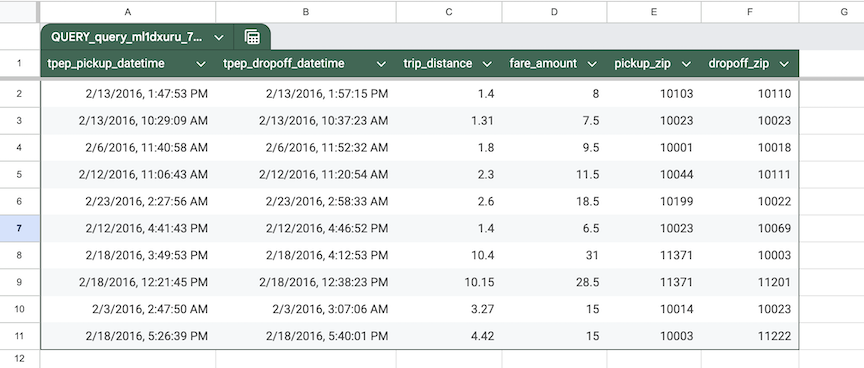
You can import data from Databricks into Google Sheets by selecting a table, writing a SQL query, or using a template. After the data is imported, the query is tied to the sheet. The connector supports importing up to the Google Sheets limit of 10 million cells.
Changing the sheet name breaks the mapping. For information on how to handle name changes, see Limitations.
If you are using "Select data" to import Unity Catalog metric views, they can only be imported as pivot tables because Unity Catalog metrics represent pivoted data.
Don't remove or modify the table formatting applied. The Google Sheets table identifier is used to refresh the import. Removing the formatting causes refresh errors.
Choose an import method to get started:
- Select data
- Write a SQL query
- Use template
To import data from a table in Databricks, do the following:
- In the Google Sheets Databricks Connector sidebar, under New import, for Import method, select Select data.
- Under Catalog, use the catalog, schema, and table drop-down menus to search for the table you want to import.
- Optionally, update the Asset Name to change the name of this import.
- Optionally, under Fields, choose which columns to include or exclude.
- You can optionally import as a pivot table.
- To add a filter, click + Filter under Filters. Select the Column to apply the filter to and the Filter type.
- Optionally, turn on Limit rows to set a limit for the number of rows to import. The limit is enabled by default and set to 1,000 rows.
- Under Output destination, select whether you want to save the query results in a new sheet or in the current sheet.
- If you select a new sheet, enter a name for the sheet.
- If you select the current sheet, specify which cell to start adding the data in.
- Click Save & Import to populate the sheet.
To write a new SQL query, do the following:
- In the Google Sheets Databricks Connector sidebar, under New import, select Write SQL.
- Databricks recommends entering a name for your query so it is identifiable.
- You can browse through catalogs, schemas, and tables.
- In Query text, enter your SQL query.
- You can optionally add query parameters.
- Under Output destination, select whether you want to save the query results in a new sheet or in the current sheet.
- If you select a new sheet, enter a name for the sheet.
- If you select the current sheet, specify which cell to start adding the data in.
- Click Save & Import to run the query and populate the sheet.
A workspace admin or a user with the CREATE CATALOG privilege must set up templates before you can import one. To import from a template, do the following:
- In the Google Sheets Databricks Connector sidebar, under New import, for Import method, select Use template.
- Select a template group, then select a template. A preview lists the template's imports.
- Select the imports to bring in. All imports are selected by default.
- Click Import Templates. Each selected import is added to a new sheet and then behaves like any other saved import.
Query execution times out after 15 minutes. If your query exceeds this limit, it is automatically canceled. For large result sets, the first 1,000 rows are written immediately, with remaining data fetched progressively. If data fetching is interrupted, partial results remain in your sheet and can be cleared by re-running the query.
Add query parameters (optional)
To add query parameters to your SQL query:
-
Ensure your query has at least one query parameter, in the format of
:parameter_name. For more on query parameters, see Use named parameter markers. -
Click + Add Parameter.
-
Enter the parameter in the first box. Make sure the parameter name matches what you entered in the query editor.
-
Enter the sheet name and cell location of your parameter value in the second box, including the exclamation point after the sheet name.
-
To add more query parameters, click + Add Parameter again.
For example, the following query includes the query parameter
:trip_distance, which is defined in sheetsheet_1, cell H1.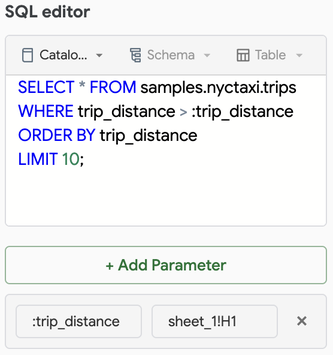
Import as a pivot table (optional)
To import your data as a pivot table, do the following:
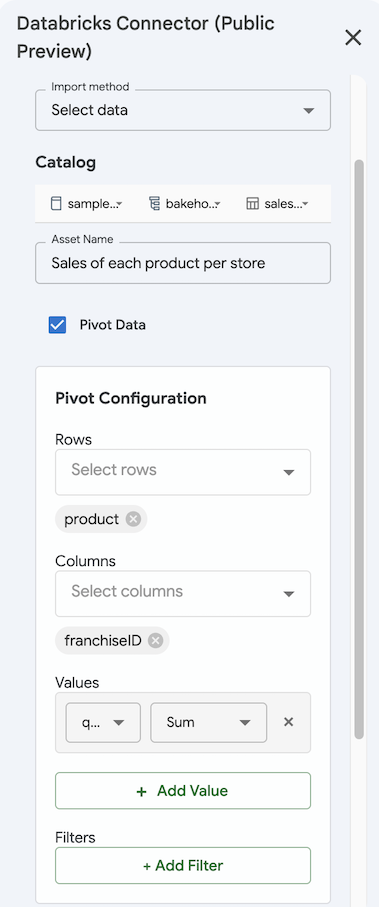
- To import data using the Select data method, select the Pivot table checkbox.
- Under Pivot Configuration, select the Rows and Columns for the dimensions of your pivot table.
- Specify values to aggregate by. Click + Add Value and select the column and aggregation method.
- Optionally, add filters by clicking + Add Filter and select the Column and Filter type.
- Click Save & Import to import the results as a pivot table. Import pivot tables are automatically imported to a new sheet.
Calculated fields
A calculated field is a column derived from existing data, such as profit computed from revenue and cost. The Databricks Connector for Google Sheets doesn't support creating calculated fields using the Select data import method. To add a calculated field, use one of the following methods:
- Write SQL: Use the Write SQL import method to compute calculated columns with any SQL expression. See Choose an import method.
- Genie One: Ask Genie One to return your data with the calculated columns you need, then import the results. See Use Genie One in Google Sheets.
Databricks recommends using Genie One for calculated fields.
Manage imported data
To manage the data you import from Databricks, do the following:
-
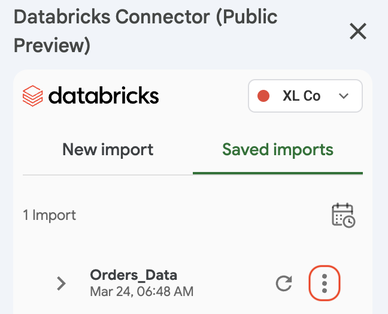
Click the Saved imports tab in the connector sidebar.
-
To manually refresh imported data:
- Refresh a single import: Click the refresh icon next to the query name.
- Refresh all imports: Click the refresh icon at the top of the Saved imports tab, next to the calendar icon.
To automatically refresh imports on a recurring schedule, see Schedule data refreshes in Google Sheets.
-
To see which sheet an import is connected to, click
 > Go to Sheet next to the query name.
 -
To edit an import, click
> Edit next to the query name. -
To delete an import, click
> Delete next to the query name. This deletes the query, not the data imported into Google Sheets. You must manually delete imported data.
Sharing implications
The add-on does not impact your ability to share your Google Sheet. However, the way you share the file impacts the actions that your recipients can take using the add-on.
- Recipients with the Viewer or Commenter role can't access the add-on.
- Recipients with the Editor role and equivalent data asset access can use the add-on with their Google account. They can use the connector just like the owner.
- Recipients with the Editor role and the same access to the underlying resources can refresh the imports if they are logged in to the same Databricks workspace.
Move imported data
Move imported tables using the standard copy-and-paste or cut-and-paste commands:
- Copy and paste duplicates the table data.
- Cut and paste moves the imported table.
Databricks doesn't prevent you from exporting the table data.
Limitations
-
Renaming or deleting a sheet that is attached to an existing import prevents you from refreshing the import. To fix this, do one of the following:
- Recreate the sheet with the exact same name.
- Create a new import by choosing Select a Query as the source, reusing the import, and clicking Save as New.
-
If two queries map to the same or overlapping ranges, the add-on displays the results of the most recently executed query. This overwrites previously imported data.
-
When you import a template, a query whose parameter points to a cell isn't run automatically. The connector saves the query and prompts you to configure the parameter before you run it. See Templates in Google Sheets.