Databricks Genie app in Microsoft Teams
This feature is in Public Preview. Account admins can manage access to this feature from the account console Previews page. See Manage account-level previews.
The Databricks Genie app in Microsoft Teams brings Genie into Microsoft Teams so users can ask data questions and get answers without leaving the Microsoft Teams workspace. Users can chat with the app in a direct message or mention @Databricks Genie in a Microsoft Teams channel or group chat. Questions are answered by Genie One or by a specific Genie Agent that a channel owner has pinned for consistent, use-case-specific answers.
The Databricks Genie app in Microsoft Teams relies on the Genie One API in both cases; when a Genie Agent is pinned, Genie One sends the question to only that agent. The app uses the same model providers and trust and safety guarantees as Genie. See Hosting provider used when partner-powered AI features setting is enabled and disabled and Databricks AI assistive features trust and safety.
This page describes how to download, set up, and use the Databricks Genie app in Microsoft Teams.
Databricks agents may generate inaccurate responses. Verify before acting on agent output.
Prerequisites
Before installing the Databricks Genie app in Microsoft Teams:
- An account admin must enable the Databricks Genie for Microsoft Teams preview in the account console.
- If your workspace uses an IP access list, add the outbound IPs of the Databricks control plane in the East US 2 region. See the Outbound IPs in the Azure Databricks documentation.
Install the Databricks Genie app in Microsoft Teams
A Microsoft 365 admin installs the Databricks Genie app in Microsoft Teams from the Microsoft marketplace:
- In the Microsoft marketplace, search for and find Databricks Genie.
- Install the app.
- Approve the app permissions when prompted during installation.
For a list of required permissions, see Required app permissions on Microsoft.
After installation, users can start using the app.
Use the Databricks Genie app in Microsoft Teams
You can use the Databricks Genie app in Microsoft Teams through direct messages or in channel conversations on your Microsoft Teams workspace, or from Microsoft 365 Copilot.
Direct message
To directly message the Databricks Genie app in Microsoft Teams:
-
In Microsoft Teams, click Apps in the left sidebar and open the Databricks Genie app in Microsoft Teams.
-
Enter your question.
-
If you are not signed in, the Databricks Genie app in Microsoft Teams prompts you to sign in:
- Click Configure.
- Specify your Workspace URL. To find your workspace URL, see Workspace instance names, URLs, and IDs.
- Click Continue to log in to your Databricks account.
-
Your question is routed to the most appropriate Genie Agent and returns an answer with sources and suggested follow-up prompts.
To start a new conversation in a direct message, send newchat. This clears the current conversation context so that your next message starts a new Genie conversation. Your existing Microsoft Teams messages are not deleted.
To configure the workspace and Genie scope for all subsequent direct message conversations, open the Databricks Genie app in the Microsoft Teams home page and adjust the settings.
Channel conversation
You can add the Databricks Genie app in Microsoft Teams to a channel. Using config, channel owners can configure settings for all members of a channel and individual users can configure personal settings. Channel owner configurations override personal configurations.
To configure the Databricks Genie app in Microsoft Teams in a channel:
-
In the desired channel, type
@Databricks Genie. -
If prompted, add the Databricks Genie app in Microsoft Teams to the channel.
-
Type
config. -
Select the connected workspace, the message visibility, and the Genie scope (Genie One or a specific Genie Agent).
If no Genie Agent is pinned, the channel defaults to Genie One.
-
After configuration, all
@Databricks Geniementions in the channel route to the configured agent and workspace.
Visualizations
When a Genie response includes a visualization, the chart appears as an image in the reply.
Visualizations are not shown when message visibility is set to private, because private messages are visible only to the user who asked.
Configuration levels and overrides
Run config in a channel to open the configuration window. The following settings are configurable:
- Workspace Selection: The Databricks workspace the Databricks Genie app in Microsoft Teams connects to for answering questions.
- Message visibility: Whether
@Databricks Genieresponses in channels are visible to all channel members or only to the user who asked. By default, responses are public. - Genie scope: Genie One or a specific Genie Agent. Both use the Genie One API; pinning a specific Genie Agent directs Genie One to send the question to only that agent, for consistent, use-case-specific answers.
Message visibility settings can be set at three levels. Higher levels override lower levels:
Level | How to set it | Applies to | Precedence |
|---|---|---|---|
Workspace | Databricks workspace admin configures from workspace security settings using the Allow connection to collaboration platforms and Allow public messages in collaboration platforms fields. When Allow public messages in collaboration platforms is off, all responses are private to the user who asked. | All channels in the Microsoft Teams workspace | Highest, overrides channel and personal configurations |
Channel | Channel owner sends | All members in that channel | Overrides personal configurations |
Personal | Individual user sends | That user's own | Used when no channel-wide configuration is set |
Monitor usage with audit logs
Account and workspace admins can use the audit log system table (system.access.audit) to monitor Genie usage that comes from Microsoft Teams. When a user sends a message through the Databricks Genie app in Microsoft Teams, Genie One logs a createGenieChatResponse event under the genieChat service, and the request_params.source field records teams as the origin. This lets you distinguish Microsoft Teams requests from requests made in the Databricks web UI (webapp) or through other integrations, such as Slack (slack).
The following sample query returns the Microsoft Teams-originated Genie requests from the last 5 days, including the user who asked and the conversation ID:
SELECT
  event_time,
  user_identity.email AS user_email,
  request_params.conversation_id AS conversation_id
FROM system.access.audit
WHERE service_name = 'genieChat'
  AND action_name = 'createGenieChatResponse'
  AND request_params.source = 'teams'
  AND event_date >= date_add(current_date(), -5)
ORDER BY event_time DESC
For the audit log table schema and more sample queries, see Audit log system table reference. For the full list of Genie One chat events, see Chat events in Genie One.
Data routing
Genie processes your questions and stores conversation history in your workspace's region. However, the Databricks Genie app in Microsoft Teams runs in the Databricks control plane in the East US 2 region, regardless of your workspace's region.
Your prompt routes through the app in East US 2, and the answer routes back through it. The app does not store or log your prompt or answer content there. It stores only mapping information, such as the association between a Microsoft Teams workspace and a Databricks workspace.
Required app permissions on Microsoft
When you install the Databricks Genie app in Microsoft Teams, it requests the following permissions. Entra ID permissions are tenant-wide Microsoft Graph permissions that a Microsoft 365 admin consents to for your organization. Resource-specific permissions are Teams resource-specific consent (RSC) permissions that apply only to the chat, channel, or team where the app is installed.
For more information about these permissions, see Resource-specific consent and Graph permissions in the Microsoft documentation.
The User.ReadBasic.All permission is no longer used. The app now uses delegated permissions instead. Until Databricks finishes removing it as a required permission, you might still see it requested during installation. Approve the request if you're prompted.
Permission | Description | Type |
|---|---|---|
| Maintain access to data you have granted it access to. | Entra ID |
| Sign in and read the user profile. | Entra ID |
| Read all users' basic profiles. | Entra ID |
| Read the messages in this chat. | Resource-specific |
| Send messages to this chat. | Resource-specific |
| Create new notifications in the teamwork activity feeds of users in this chat. | Resource-specific |
| Send activity feed notifications to this user. | Resource-specific |
| Read the members of channels of a team. | Resource-specific |
| Read this team's channel messages. | Resource-specific |
| Read this team's channel names, descriptions, and settings. | Resource-specific |
Troubleshooting
"Need admin approval" message on log in
The following "Need admin approval" message appears when you log in to your Databricks workspace because the Microsoft Entra tenant is blocking user consent for the Databricks application. If administrator consent is not granted, Microsoft Entra ID continues to block the login flow even if you have direct workspace access.
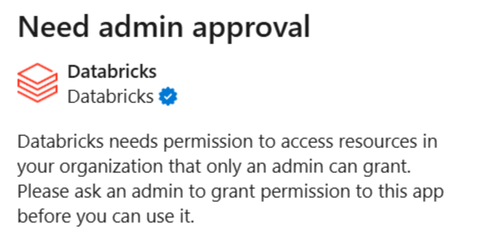
To resolve this, a Microsoft Entra user with appropriate administrator roles must grant tenant-wide administrator consent to the Databricks enterprise application.
Ask the Microsoft Entra admin to visit the following link. Replace {TENANT_ID} with your Microsoft Entra tenant ID:
https://login.microsoftonline.com/{TENANT_ID}/adminconsent?client_id=aaec40b0-c0ae-4211-a98b-6fc160abb71b
If the link fails, the admin can grant consent manually:
- In the Microsoft Entra admin center, go to Entra ID > Enterprise apps > All applications and find the Databricks enterprise application used for single sign-on. To identify the application, search for the Application ID
aaec40b0-c0ae-4211-a98b-6fc160abb71b. - Grant admin consent for the permissions requested by the Databricks enterprise app:
- Under Security, click Permissions.
- Click Grant admin consent.
For detailed instructions, see the Microsoft documentation.
Limitations
- You cannot specify which compute (SQL warehouse) the Databricks Genie app in Microsoft Teams uses. Databricks automatically selects a SQL warehouse that the user is authorized to access.
- When a specific Genie Agent is pinned as the Genie scope, Genie One might rewrite the question before it reaches the pinned agent.
- Feedback (thumbs up or thumbs down) is always sent to Genie One, even when a specific Genie Agent is pinned.
- PrivateLink is not supported.
- Triggering actions in Databricks from Teams is not supported.
Additional resources
- Use Genie One
- Chat in Genie One
- Slack and Microsoft Teams Genie app destinations
- For support, see the Databricks help center.