Span concepts
The Span object is a fundamental building block in the Trace data model. It serves as a container for information about individual steps of a trace, such as LLM calls, tool execution, retrieval operations, and more.
Spans are organized hierarchically in a trace to represent your application's execution flow. Each span captures:
- Input and output data
- Timing information (start and end times)
- Status (success or error)
- Metadata and attributes about the operation
- Relationship to other spans (parent-child connections)
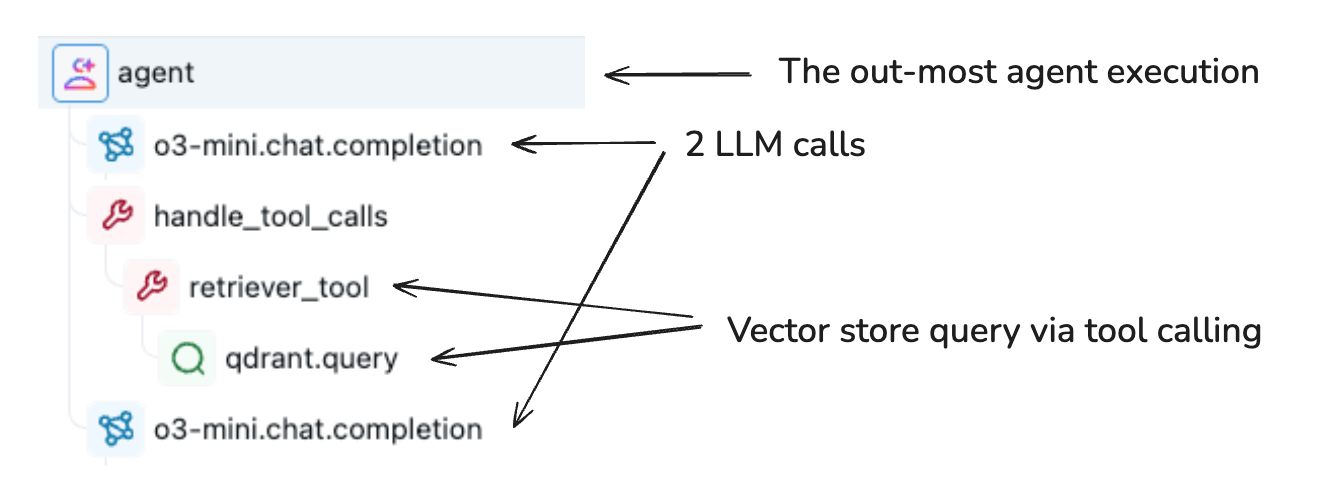
Span object schema
MLflow's Span design maintains compatibility with OpenTelemetry specifications. The schema includes eleven core properties:
Property | Type | Description |
|---|---|---|
|
| Unique identifier for this span in the trace |
|
| Links span to its parent trace |
|
| Establishes hierarchical relationship; |
|
| User-defined or auto-generated span name |
|
| Unix timestamp (nanoseconds) when span started |
|
| Unix timestamp (nanoseconds) when span ended |
|
| Span status: |
|
| Input data entering this operation |
|
| Output data exiting this operation |
|
| Metadata key-value pairs providing behavioral insights |
|
| System-level exceptions and stack trace information |
For complete details, see the MLflow API reference.
Span attributes
Attributes are key-value pairs that provide insight into behavioral modifications for function and method calls. They capture metadata about the operation's configuration and execution context.
You can add platform-specific attributes like Unity Catalog information, model serving endpoint details, and infrastructure metadata for enhanced observability.
Example of set_attributes() for an LLM call:
span.set_attributes({
    "ai.model.name": "claude-3-5-sonnet-20250122",
    "ai.model.version": "2025-01-22",
    "ai.model.provider": "anthropic",
    "ai.model.temperature": 0.7,
    "ai.model.max_tokens": 1000,
})
Span types
MLflow provides predefined SpanType values for categorization. You can also use custom string values for specialized operations.
Type | Description |
|---|---|
| Query to a chat model (specialized LLM interaction) |
| Chain of operations |
| Autonomous agent operation |
| Tool execution (typically by agents) like search queries |
| Text embedding operation |
| Context retrieval operation such as vector database queries |
| Parsing operation transforming text to structured format |
| Re-ranking operation ordering contexts by relevance |
| Memory operation persisting context in long-term storage |
| Default type when no other type specified |
Setting span types
Use the span_type parameter with decorators or context managers to set SpanType:
import mlflow
from mlflow.entities import SpanType

# Using a built-in span type
@mlflow.trace(span_type=SpanType.RETRIEVER)
def retrieve_documents(query: str):
    ...

# Using a custom span type
@mlflow.trace(span_type="ROUTER")
def route_request(request):
    ...

# With context manager
with mlflow.start_span(name="process", span_type=SpanType.TOOL) as span:
    span.set_inputs({"data": data})
    result = process_data(data)
    span.set_outputs({"result": result})
Searching spans by type
Query spans programmatically using MLflow search_spans():
import mlflow
from mlflow.entities import SpanType

trace = mlflow.get_trace("<trace_id>")
retriever_spans = trace.search_spans(span_type=SpanType.RETRIEVER)
You can also filter by span type in the MLflow UI when viewing traces.
Active vs. finished spans
An active span or LiveSpan is one being actively logged, such as in a function decorated with @mlflow.trace or a span context manager. Once the decorated function or context manager have exited, the span is finished and becomes an immutable Span.
To modify the active span, get a handle to the span using mlflow.get_current_active_span().
RETRIEVER span schema
The RETRIEVER span type handles operations involving retrieving data from a data store, such as querying documents from a vector store. This span type has a specific output schema that enables enhanced UI features and evaluation capabilities. The output should be a list of documents, where each document is a dictionary with:
page_content(str): Text content of the retrieved document chunkmetadata(Optional[Dict[str, Any]]): Additional metadata, including:doc_uri(str): Document source URI. When using Vector Search on Databricks, RETRIEVER spans can include Unity Catalog volume paths in thedoc_urimetadata for full lineage tracking.chunk_id(str): Identifier if document is part of a larger chunked document
id(Optional[str]): Unique identifier for the document chunk
The MLflow Document entity helps to construct this output structure.
Example implementation:
import mlflow
from mlflow.entities import SpanType, Document

def search_store(query: str) -> list[tuple[str, str]]:
    # Simulate retrieving documents from a vector database
    return [
        ("MLflow Tracing helps debug GenAI applications...", "docs/mlflow/tracing_intro.md"),
        ("Key components of a trace include spans...", "docs/mlflow/tracing_datamodel.md"),
        ("MLflow provides automatic instrumentation...", "docs/mlflow/auto_trace.md"),
    ]

@mlflow.trace(span_type=SpanType.RETRIEVER)
def retrieve_relevant_documents(query: str):
    docs = search_store(query)
    span = mlflow.get_current_active_span()

    # Set outputs in the expected format
    outputs = [
        Document(page_content=doc, metadata={"doc_uri": uri})
        for doc, uri in docs
    ]
    span.set_outputs(outputs)

    return docs

# Usage
user_query = "MLflow Tracing benefits"
retrieved_docs = retrieve_relevant_documents(user_query)
Next steps
- Trace concepts - Understand trace-level concepts and structure
- Tracing in a notebook - Get hands-on experience with tracing