Managing data with the tables editor
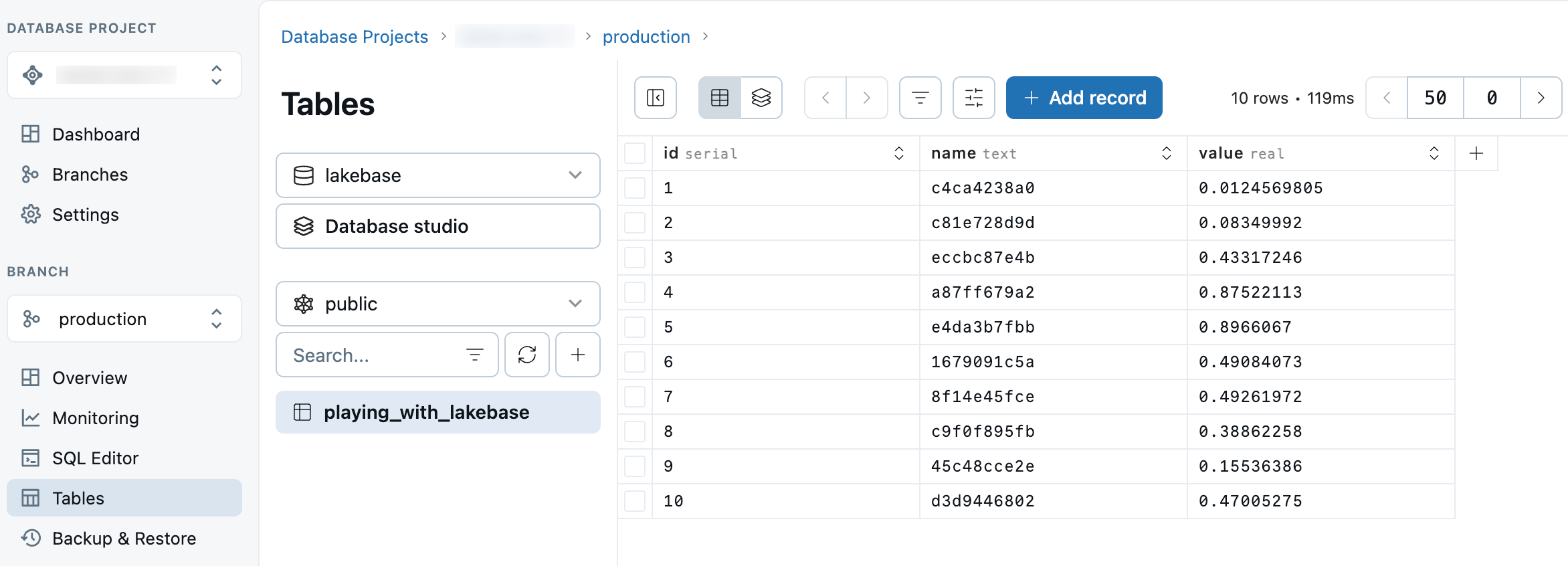
The Tables editor in Lakebase offers a visual interface for managing data and schemas. Use it to add, update, and delete records, filter data, and modify columns. You can also drop or truncate tables, export data in both JSON and CSV formats, and manage schemas, tables, views, and enums.
Edit records
Edit individual entries directly within the table interface. Click a cell to modify its contents. You don't have to select Enter (though you can). Move your cursor to the next cell you want to modify. Click Save x changes when you're done.
Add records
Add new records to your tables using the Add record button.
- You must press
Enterfor your input to register. When editing existing fields, you don't have to do this. But for new fields, if you tab to the next cell, you'll lose your input. - You can leave
DEFAULTfields untouched and the cell will inherit the right value based on your schema definition. For example, defaults for boolean fields are automatically applied when you click Save changes.
Toggle columns
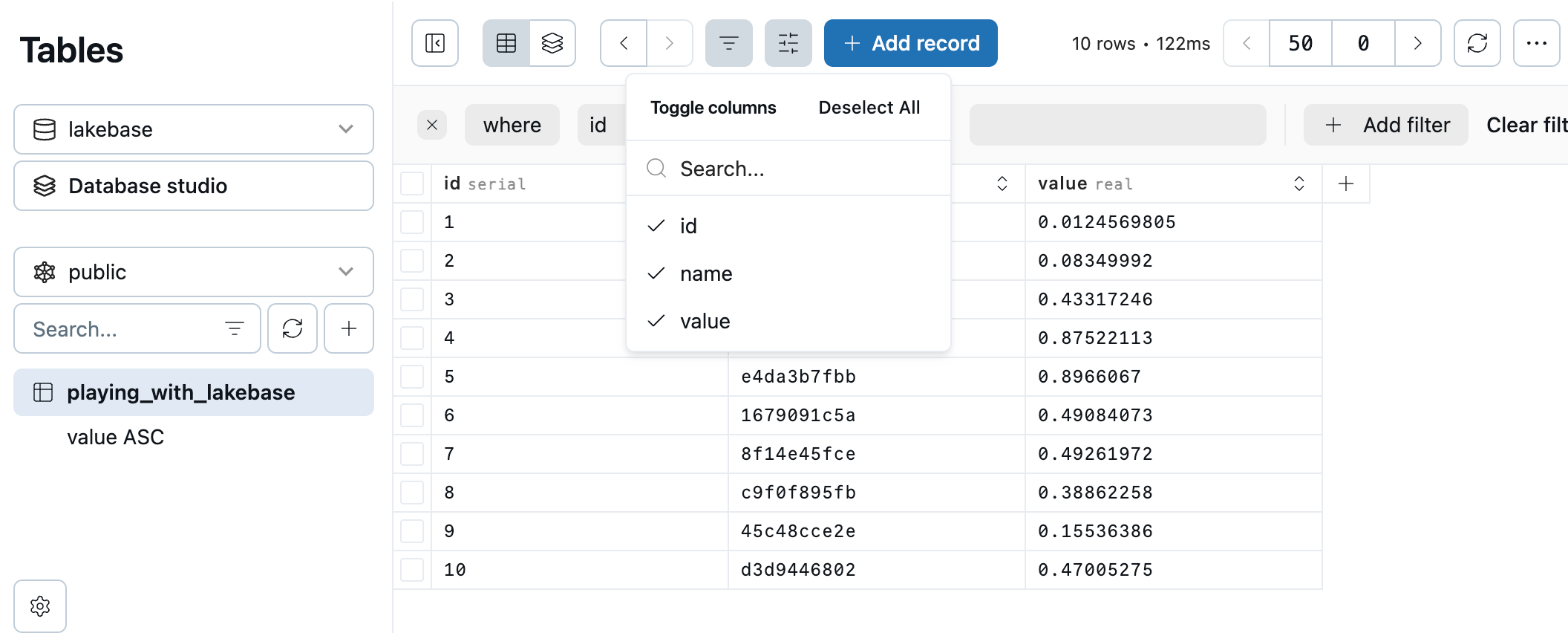
You can simplify your view by hiding (or showing) individual columns in the table. You're not modifying content here. Clear a checked column to hide it, and re-select the column to show it again. The Tables editor saves your selections as a persistent filter.
Add filters
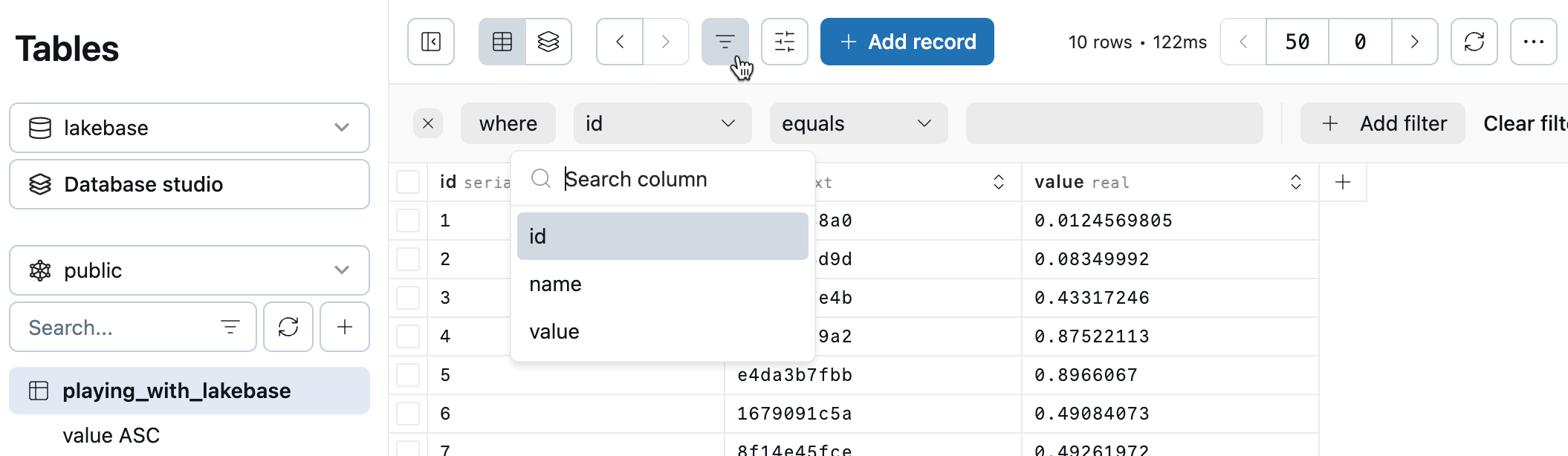
Use filters to store simplified views of your data that you can come back to later. You can use dropdown-filtering to select columns, conditions, and input text for the filter.
Each new filter is added as a View under your list of Tables.
Delete records
Use the checkboxes to mark any unwanted records for deletion, or use the select-all checkbox for bulk deletion. Click Delete x records to complete the process.
Export data
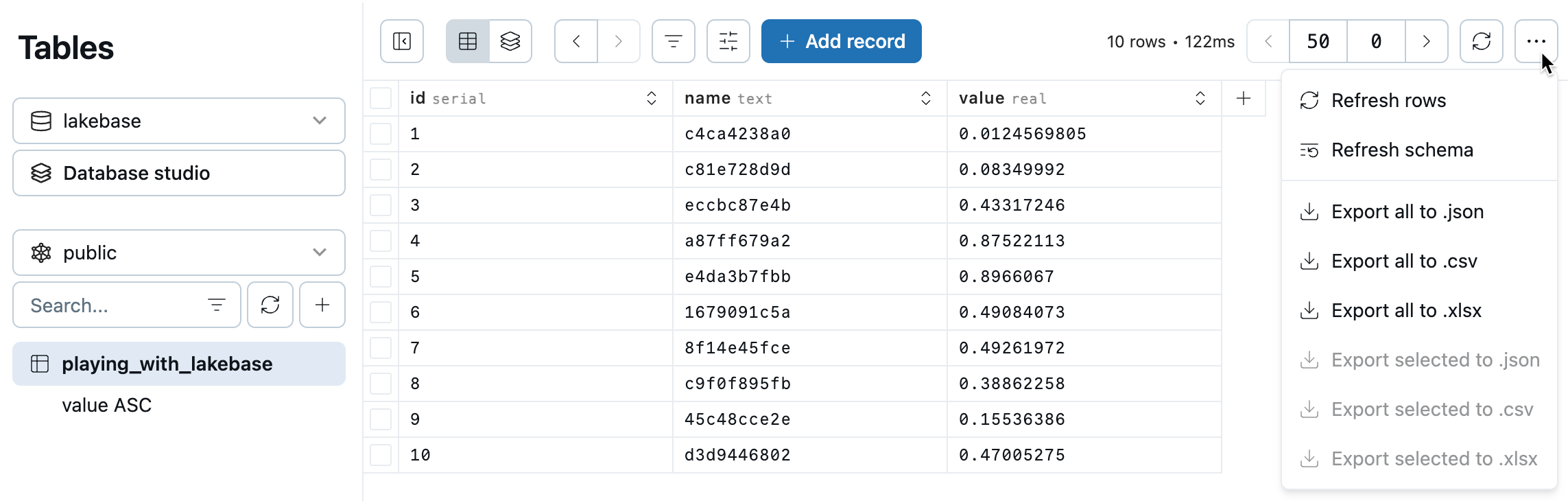
Use the checkboxes to mark records for export. Select the records you want to include in your export, then select Export selected... from the export drop-down menu.
Or select Export all... to download the entire contents of the table.
You can export to JSON, CSV, or XLSX.
Manage schemas
In addition to managing data, you can manage your database schema directly from the Tables editor. Schema management options include:
- Creating, altering, and dropping schemas
- Creating and altering tables
- Creating and altering views
- Creating enums
- Refreshing the database schema
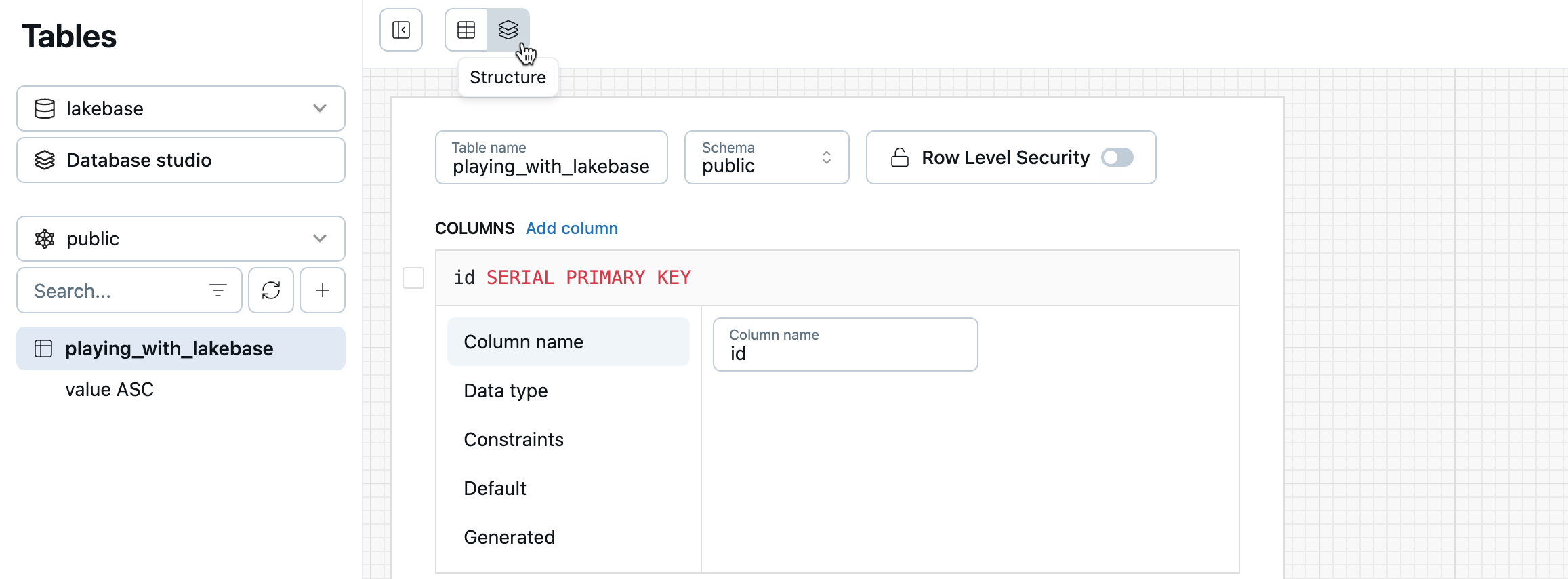
Database studio view
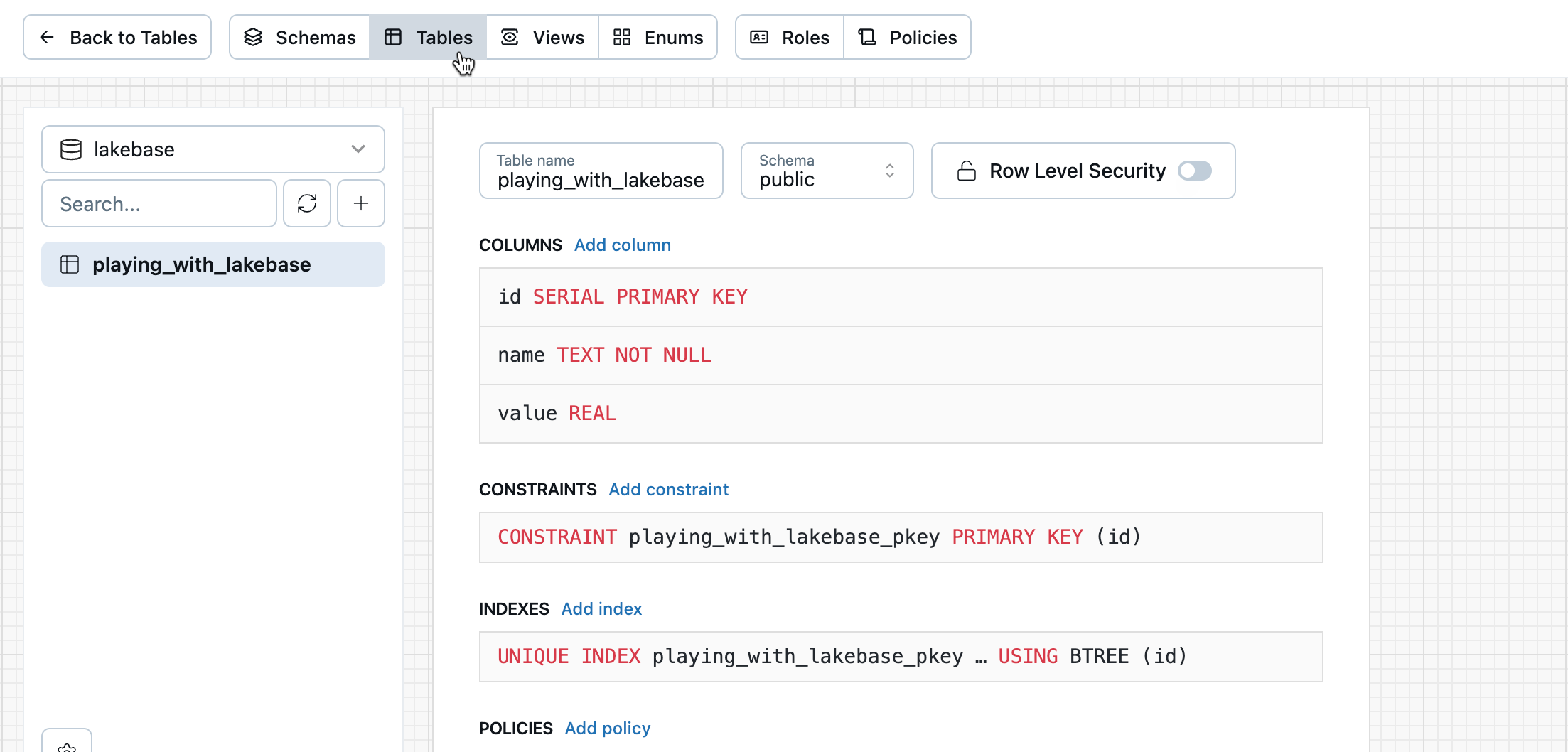
Use Database studio to explore your database objects—including schemas, tables, views, roles, and policies—all in one place.
To open the view, select Database studio from the Tables editor.

Use the top navbar to go to different database objects and views.
Troubleshoot
HTTP 507 "response is too large": If the Tables editor displays an HTTP 507 error with the message "response is too large (max is 67108864 bytes)", the table preview has exceeded the maximum supported result size of 64 MB. This can occur when previewing tables with large payloads, such as columns containing large BYTEA values. This is a preview size limitation. To view or query the data, connect to Lakebase from a PostgreSQL client. See Postgres clients.
"Failed to fetch" or "Unknown error": If the Tables editor displays one of these messages and your workspace uses Private Link, confirm that inbound Private Link (workspace-level, port 443) is correctly configured. See Troubleshoot Private Link connectivity.