Private Link concepts
This page provides a general overview of Private Link at Databricks. Private Link creates a private, secure connection between your Databricks resources and your AWS services and serverless resources, ensuring your network traffic isn't exposed to the public internet.
Databricks supports three types of Private Link connectivity:
- Inbound (front-end): Secures connections from users to workspaces and account-level resources (for example, the account console and account-level Genie)
- Outbound (serverless): Secures connections from Databricks serverless compute to your customer resources
- Classic (back-end): Secures connections from classic compute to the control plane
Private connectivity overview
Private Link enables secure, private connectivity from your AWS VPCs and on-premises networks to AWS services, ensuring that your traffic remains isolated from the public internet. End-to-end private networking helps you meet security and compliance requirements and reduces the risk of data exfiltration.
You can enable inbound (front-end), outbound (serverless), or classic compute (back-end) Private Link connections independently, or a combination of the three, depending on your security and compliance requirements. For example, you can enforce private connectivity to your Databricks resources while rejecting all public network connections automatically. This combined approach delivers comprehensive network isolation, reducing your attack surface and supporting compliance for sensitive workloads.
With Private Link, you can:
- Block data access from unauthorized networks or the public internet when using the Databricks web application or APIs.
- Lower the risk of data exfiltration by restricting network exposure to approved private endpoints only.
Choose the right Private Link implementation
Use this guide to determine which implementation best fits your needs.
Consideration | Inbound (front-end) only | Outbound (serverless) only | Classic compute plane (back-end) only | Complete private isolation |
|---|---|---|---|---|
Primary security goal | Only authorized individuals can access my Databricks resources. | Secure data access from serverless | Lock down classic compute plane | Maximum isolation (secure everything) |
User connectivity | Private or public | Public (internet) | Public (internet) | Private only |
Serverless data access | Public (internet) | Private (to customer resources) | Public (internet) | Private (to customer resources) |
Cluster connectivity to control plane | Public (standard secure path) | Public (standard secure path) | Private (required) | Private (required) |
Prerequisites | Enterprise plan | Enterprise plan | Enterprise plan, customer-managed VPC, SCC | Enterprise plan, customer-managed VPC, SCC |
Relative cost | Cost per endpoint and data transfer | Cost per endpoint and data processed | Cost per endpoint and data transfer | Can be a higher cost (all endpoints, including data transfer and processing) |
Inbound connectivity (front-end)
Inbound Private Link secures the connection from users to Databricks workspaces and account-level resources. Traffic routes through a VPC interface endpoint in your transit VPC instead of public IPs. Inbound Private Link provides secure access to:
- Databricks web application
- REST API
- Databricks Apps
- Databricks Connect API
- Databricks performance-intensive services
- Account-level Genie One
See Configure front-end Private Link.
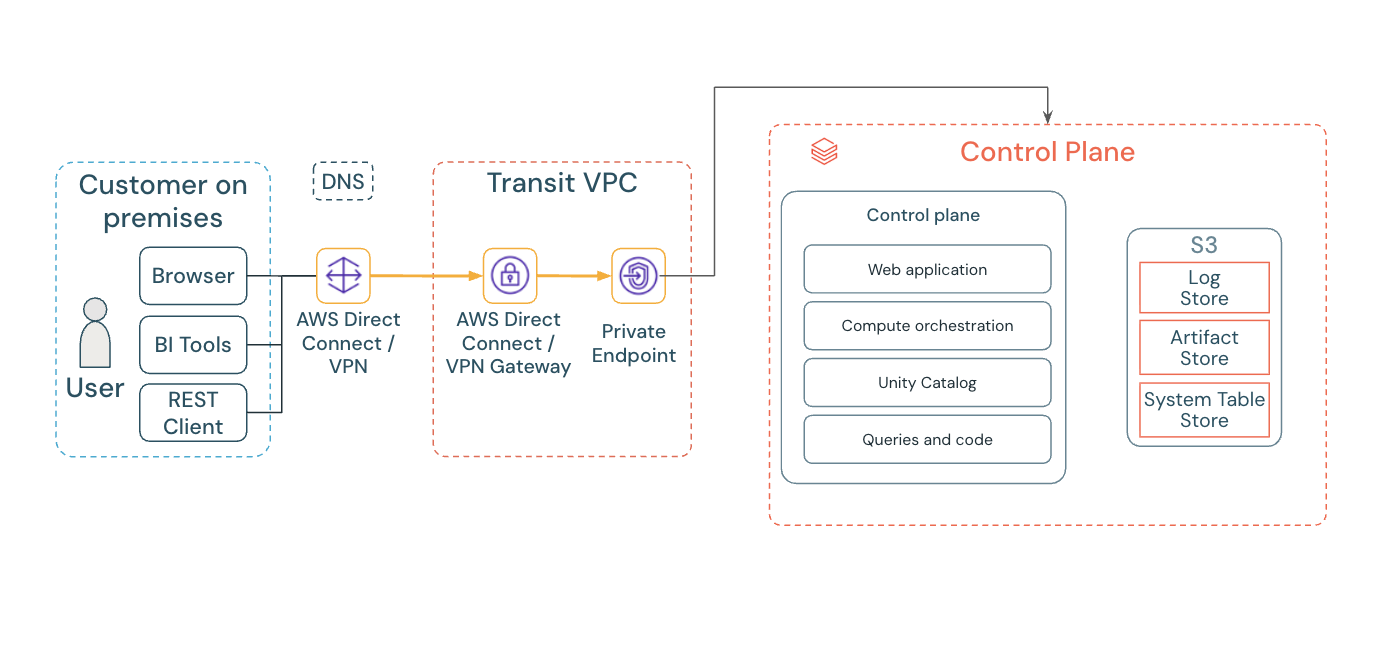
 Inbound private connectivity to performance-intensive services
Inbound private connectivity to performance-intensive servicesInbound private connectivity to performance-intensive services
Private Link for performance-intensive services provides private connectivity to the following services:
- Zerobus Ingest
- Lakebase Autoscaling
See Configure inbound Private Link for performance-intensive services.
Outbound connectivity (serverless)
Outbound Private Link enables private connectivity from Databricks serverless compute resources to your AWS resources. Unlike inbound and classic compute plane Private Link, which secure connections to Databricks, outbound Private Link secures connections from serverless compute to your customer resources.
Serverless Private Link uses network connectivity configurations (NCCs), which are account-level regional constructs that manage private endpoint creation at scale. NCCs can be attached to multiple workspaces in the same region.
Private connectivity to AWS-managed resources
Private connectivity to AWS-managed resourcesPrivate connectivity to AWS-managed resources
Enables serverless compute to access AWS-managed resources in your workspace region through AWS Private Link without traversing the public internet. Your data traffic remains entirely within the AWS network.
See Configure private connectivity to AWS-managed resources.
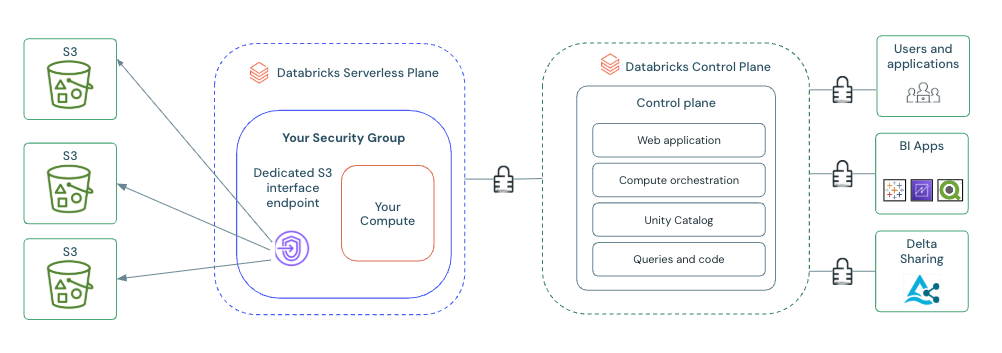
Private connectivity to VPC resources
Private connectivity to VPC resourcesPrivate connectivity to VPC resources
Enables serverless compute to access resources in your VPC, such as databases and internal services, through private endpoints.
See Configure private connectivity to resources in your VPC.
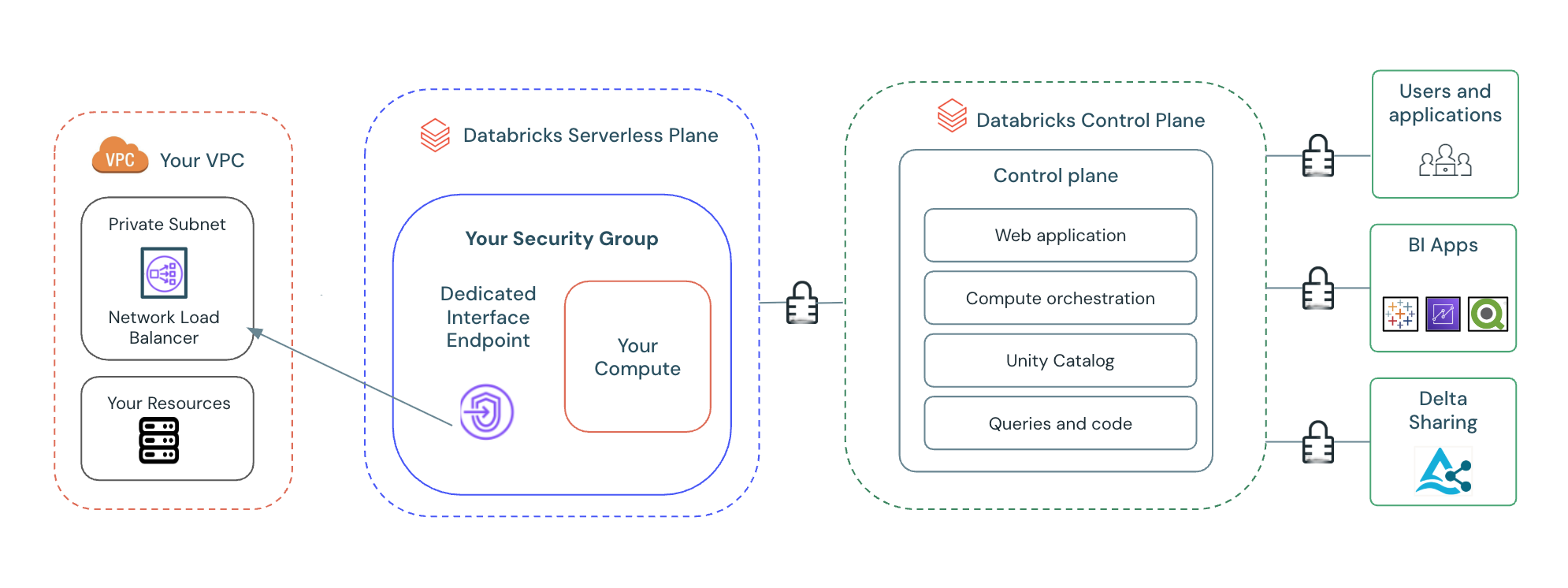
 Key concepts for outbound connectivity
Key concepts for outbound connectivityKey concepts for outbound connectivity
- Network connectivity configuration (NCC): An account-level regional construct that manages private endpoints and controls how serverless compute accesses customer resources.
- Private endpoint rules: Define the specific resources that serverless compute can access privately.
- Workspace attachment model: NCCs can be attached to up to 50 workspaces in the same region.
- Limits and quotas:
- Up to 20 NCCs per region per account
- 30 private endpoints per region for S3 (distributed across NCCs)
- 100 private endpoints per region for VPC resources (distributed across NCCs)
- Up to 50 workspaces per NCC
Classic compute plane private connectivity
Classic compute plane private connectivity Private Link secures the connection from Databricks clusters to the control plane. Clusters connect to the control plane for REST APIs and secure cluster connectivity relay.
Classic compute plane connectivity Private Link addresses:
- Compliance requirements: Helps meet strict regulatory and corporate compliance mandates that require all internal cloud traffic to remain on a private network.
- Network perimeter hardening: Implementing classic compute plane Private Link alongside VPC endpoints for AWS services (such as S3, STS, and Kinesis) allows you to remove internet gateways from your VPC. This reduces data exfiltration risks by ensuring that data-processing clusters have no path to unauthorized services or destinations on the public internet.
See Configure back-end Private Link.
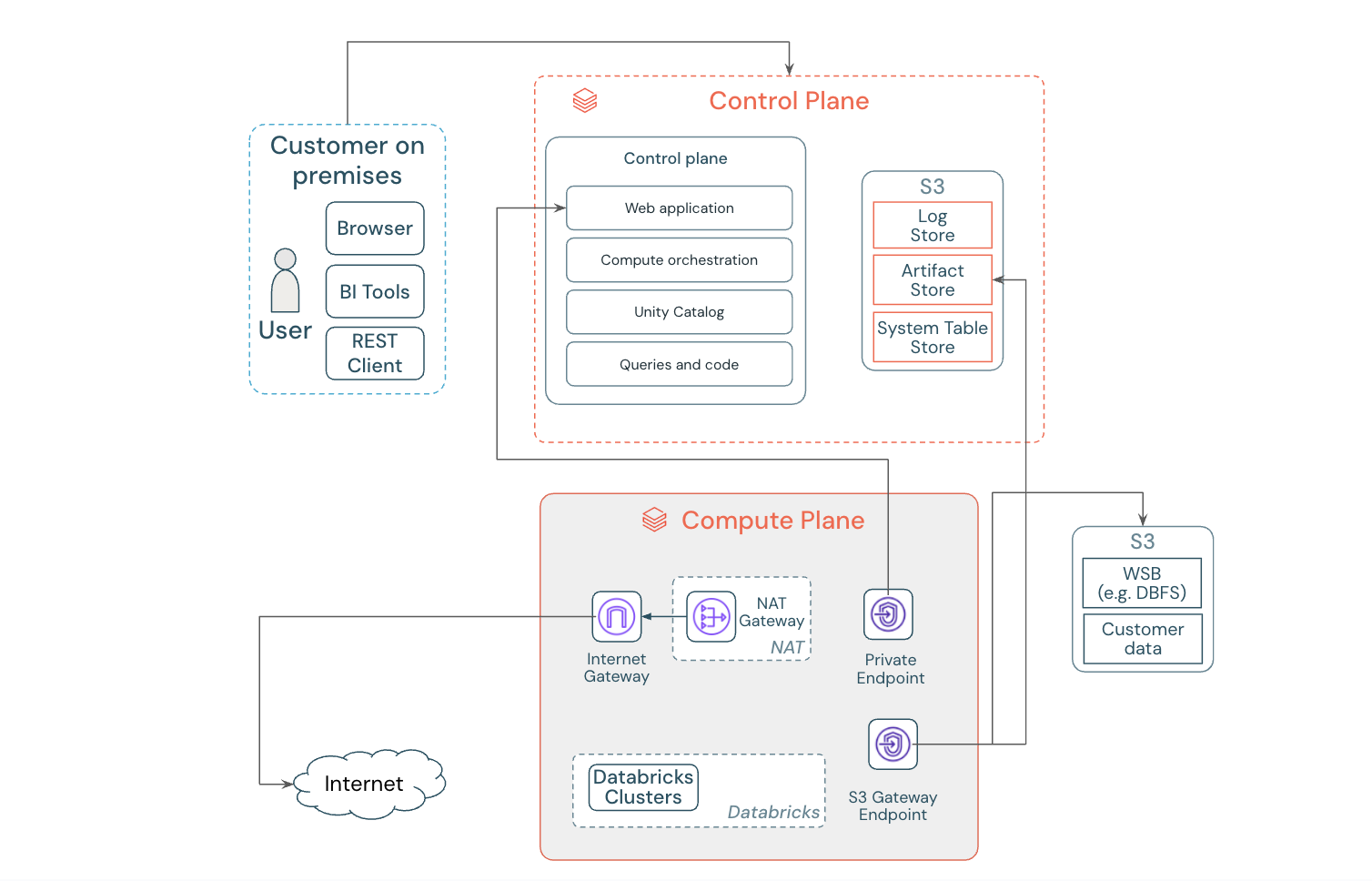
You can set up classic compute plane private connectivity independently; it doesn't require inbound or serverless connectivity.
Virtual private clouds for private connectivity
Private connectivity uses two distinct virtual private clouds (VPCs).
- Transit VPC: This VPC functions as a central hub for user connectivity and contains the inbound VPC endpoint required for client access to workspaces. You can have more than one transit VPC.
- Compute Plane VPC: This is a VPC you create to host your Databricks workspace and classic VPC endpoints.
In some deployments, a single VPC can serve both functions by reusing the same REST API/WebApp endpoint for inbound, outbound, and classic compute plane Private Link.
Subnet allocation and sizing
Plan your subnets in each VPC to support private connectivity and deployments.
-
Transit VPC subnets:
- Inbound VPC endpoint subnet: Allocates IP addresses for inbound VPC endpoints.
-
Compute plane VPC subnets:
- Workspace subnets: Databricks workspace deployment requires at least two subnets in separate Availability Zones. For sizing information related to workspace subnets, see Subnets.
- VPC endpoint subnet: An additional subnet is recommended to host VPC endpoints for the private connectivity of classic compute plane.
Databricks VPC endpoints
Databricks uses distinct types of VPC endpoints to privatize traffic. Understand their different roles to implement them correctly.
- General Access endpoint: This is the primary VPC endpoint for securing traffic to and from your workspaces and account-level resources. It handles REST API calls for both inbound and classic compute plane Private Link.
- SCC relay endpoint: This VPC endpoint is specifically for secure cluster connectivity (SCC) between the compute plane and control plane. Classic compute plane Private Link requires this endpoint. See What is secure cluster connectivity?.
- Service Direct endpoint: This endpoint is needed to access performance-intensive services.
Within the same VPC, Databricks recommends at most one endpoint per endpoint type. Share one General Access endpoint across all workspace and account-level access and one SCC relay endpoint for all SCC relay access from that VPC.
For VPC endpoints, note the following:
- Shared endpoints: VPC endpoints can be shared across multiple workspaces and account-level resources in any region for General Access. For classic compute plane connectivity, a single set of VPC endpoints can serve all workspaces deployed in that VPC and region.
- Region-specific: VPC endpoints are region-specific resources. For Service-Direct and SCC relay endpoints, workspaces in different regions require separate VPC endpoint configurations. For General Access endpoints, workspaces in different regions can share a single endpoint in any region.
Key considerations
Before you configure private connectivity, keep the following in mind:
- Network ACL requirements: Databricks requires subnet-level network ACLs to add
0.0.0.0/0to your allow list. To control egress traffic, use an egress firewall or proxy appliance to block most traffic but allow the URLs that Databricks needs to connect to. See Configure a firewall and outbound access. - Port 3306 metastore connectivity (legacy HMS only): This port is only applicable for legacy workspaces using the deprecated Hive Metastore. New workspaces have the legacy Hive Metastore disabled by default. For legacy workspaces, port 3306 doesn't use Private Link for connectivity to the control plane. For metastore connectivity between compute and control planes, traffic traverses a publicly routable network space using an encrypted connection. The publicly resolvable FQDNs for the Databricks-hosted RDS instances that house the HMS are available at RDS addresses for legacy Hive metastore.
- Security group best practices: Follow the principle of least privilege by creating dedicated security groups for your VPC endpoints:
- Compute cluster security group: Must allow outbound TCP traffic to the VPC Endpoint security group on the required ports (443, 3306, 6666, etc.). See Security groups
- VPC Endpoint security group: Must allow inbound TCP traffic from the compute cluster security group on those same ports.