Connect serverless compute to on-premises resources using an SSH reverse tunnel
An SSH reverse tunnel connects serverless compute to on-premises resources without opening inbound ports on your on-premises firewall. An on-premises host opens an outbound SSH connection to proxy VMs in your AWS environment, which gives serverless compute a secure, encrypted path to your on-premises resources.
This is a self-managed solution. You provision, monitor, and maintain the proxy VMs and the on-premises tunnel host.
What problem it solves
An SSH reverse tunnel establishes a dedicated, private connection from serverless compute to on-premises resources without requiring you to open an inbound port on your on-premises firewall. The on-premises host initiates the connection outbound, and traffic from serverless compute flows back over the established tunnel.
When to use an SSH reverse tunnel
Use an SSH reverse tunnel when your on-premises resources are reachable from the cloud over an existing network path, such as AWS Direct Connect, a site-to-site VPN, or SD-WAN, but your corporate firewall blocks inbound traffic from the cloud.
How it works
- On-premises tunnel hosts run
autosshto establish outbound SSH connections to proxy VMs in AWS. - The proxy VMs run
socatto accept the tunnels and expose resource ports on their network interfaces. - Databricks connects to the proxy VMs from a private endpoint in your network connectivity configuration (NCC), through a Network Load Balancer that is exposed through a virtual private cloud (VPC) endpoint service.
- Serverless traffic flows through the tunnel to the on-premises resources.
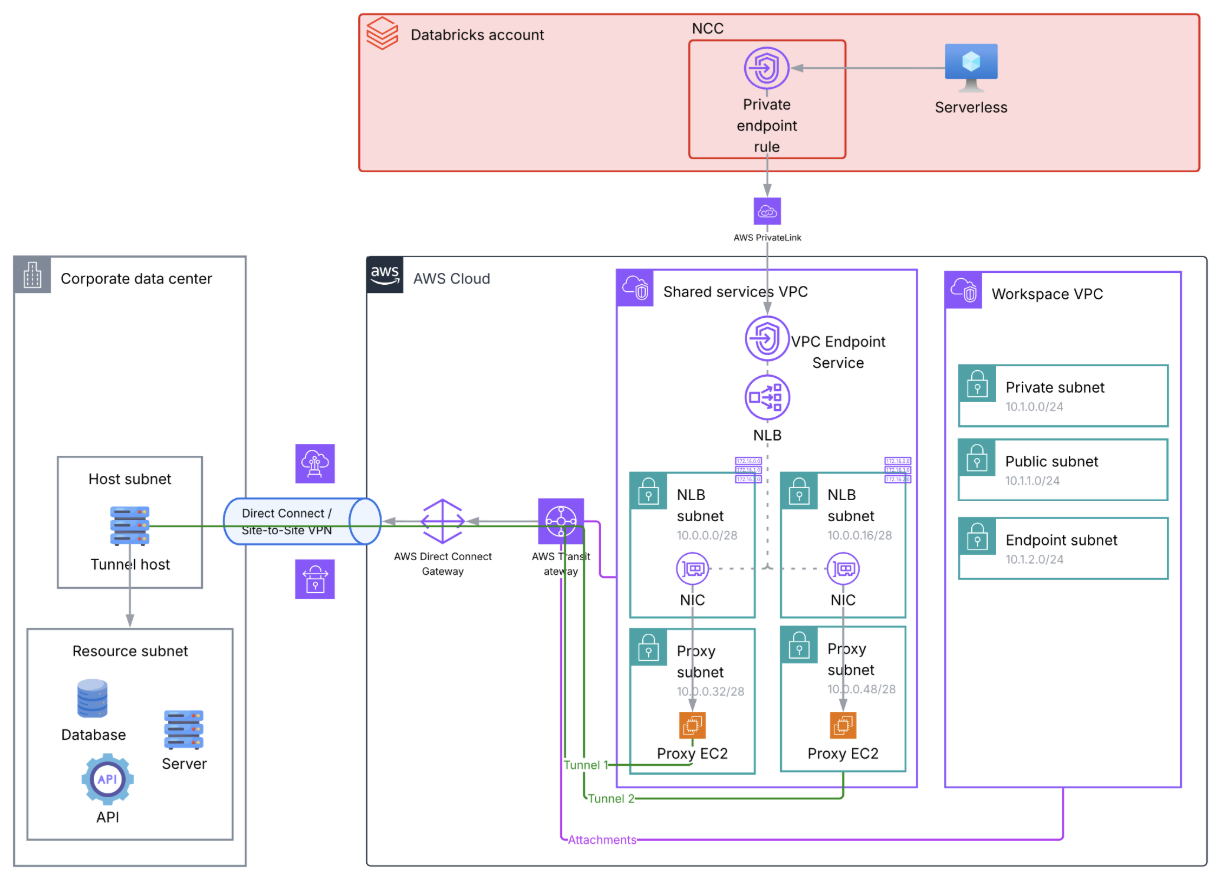
For detailed setup steps, see Connect to on-premises resources using an SSH reverse tunnel.
Considerations
Review the following before you use an SSH reverse tunnel:
- This is not a managed solution. You must provision, monitor, and maintain infrastructure both in the cloud and on-premises, which adds cost and operational overhead.
- Add at least two proxy VMs to the load balancer backend pool so that a tunnel failure on a single VM doesn't block connectivity.
- Each proxy VM requires a distinct port mapping for each on-premises resource.