Databricks tables concepts
Databricks supports three primary table types (managed, external, and foreign) and two open storage formats (Delta Lake and Apache Iceberg). Choosing the right combination determines how data is stored, governed, and optimized.
A Databricks table resides in a schema and contains rows of data. The default table type created in Databricks is a Unity Catalog managed table.
Storage formats
Storage formats define how data is physically structured and tracked in object storage.
Databricks supports two primary open table storage formats:
- Delta Lake is the default storage format for managed and external tables in Databricks. Delta is also supported for foreign tables.
- Apache Iceberg is supported for managed and foreign tables in Databricks. This format is useful when you're integrating with the Iceberg ecosystem.
Both formats add a transactional storage layer that tracks metadata and supports Atomicity, Consistency, Isolation, and Durability (ACID) compliance, time travel, and other features.
Table types
Table types in Databricks define how data is owned and accessed.
Databricks supports three primary table types. Table types are determined by which catalog owns and manages the underlying data files, as described in the following table:
For information on how to select the correct table type for your use case, see Select a table type.
Managed tables
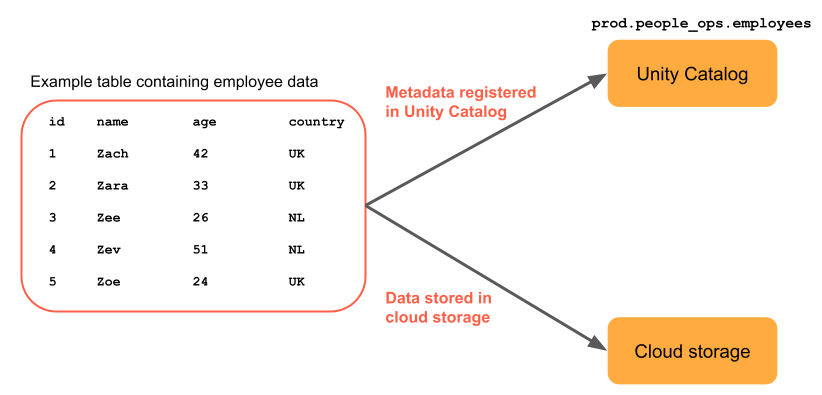
For managed tables, Unity Catalog manages both the data files and the table metadata. The data files are stored in Unity Catalog's managed storage location in cloud storage. Unity Catalog managed tables are the default when you create tables in Databricks.
Databricks recommends that you use managed tables whenever you create a new table. Managed tables automatically implement performance improvements, reduce storage and compute costs, and enable access for external systems, such as Trino. See Managed tables.
The following example shows a managed table named prod.people_ops_employees that contains data about five employees:
External tables
External tables, sometimes called unmanaged tables, reference data stored in an external storage system such as cloud object storage. Databricks registers the table metadata but doesn't manage the underlying data files. Unity Catalog supports external tables in several formats, including Delta Lake, which allows you to read them with external systems. See External tables.
Foreign tables
Foreign tables represent data stored in external systems connected to Databricks through Lakehouse Federation. Foreign tables are read-only on Databricks. See Foreign tables.
Temporary tables
Temporary tables are session-scoped tables that store data for the duration of a Databricks session. They're useful for materializing intermediate results without creating permanent tables in your catalog. Databricks automatically drops temporary tables when the session ends, and you don't need catalog or schema privileges to create them. See Temporary tables in Databricks SQL and Databricks Runtime.
Select a table type
Use managed tables for most new tables. Databricks automates optimization, storage lifecycle management, and external access.
Use external tables when:
- You need to register existing data in cloud storage without moving it.
- You require direct path-based access from non-Databricks clients.
- You're working with file formats not supported by managed tables, such as CSV or JSON.
- Dropping the table should not delete the underlying data files.
Use foreign tables when you need read-only access to data in an external system connected through Lakehouse Federation, such as a Hive metastore or AWS Glue catalog.
For storage format, Delta Lake is the default and recommended for most workloads. Use Apache Iceberg when integrating with external systems that require the Iceberg format.
Tables in Unity Catalog
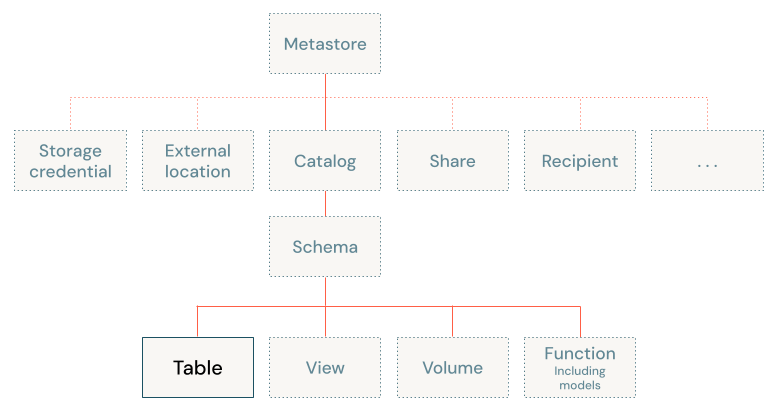
In Unity Catalog, tables exist in the third level of the three-level namespace (catalog.schema.table), as shown in the following diagram:
Basic table permissions
Most table operations require USE CATALOG and USE SCHEMA permissions on the catalog and schema containing a table.
The following table summarizes the additional permissions needed for common table operations in Unity Catalog:
Operation | Permissions |
|---|---|
Create a table |
|
Query a table |
|
Update, delete, merge, or insert data to a table |
|
Drop a table |
|
Replace a table |
|
For SQL syntax reference for these operations, see:
For more information about Unity Catalog permissions, see Manage privileges in Unity Catalog.