Lakebase release notes
This page lists new features, improvements, and behavior changes for Lakebase, the fully managed Postgres database on Databricks.
For an overview of Lakebase, see Lakebase Postgres.
Releases are staged. Your Databricks account might not be updated until a week or more after the initial release date.
Lakebase Insights moves to per-project settings, with on-demand runs (Beta)
October 19, 2026
Lakebase Insights now diagnoses issues using telemetry from the system.lakebase system tables and recommends next steps. The Lakebase Insights workspace preview enables automatic telemetry capture. Users with CAN MANAGE can configure Insights directly in each project's Settings, without creating an observability configuration.
This preview was previously named Lakebase Advanced Postgres Telemetry. Workspaces that used Insights before already have it enabled. To set up Insights:
- If the preview isn't already enabled, ask a workspace admin to enable Lakebase Insights from the Previews page. Insights needs telemetry in
system.lakebaseto analyze a project, so enabling the Insights preview also enables Lakebase Observability in System Tables if it isn't already enabled. Workspace admins can enable the observability preview separately to capture telemetry without Insights. - To schedule Insights runs for a project, you need CAN MANAGE on that project. Enable Insights and set its analysis frequency in Settings.
- You can run Insights on demand at any time, with or without a schedule.
If you scheduled Insights through an observability configuration, those jobs have stopped. Their schedules do not carry over. Those configurations no longer write telemetry to their Unity Catalog destinations, so their dashboards retain historical data but receive no new data.
To continue receiving scheduled insights, enable Insights and set an analysis frequency in each project's Settings. Each project runs separately, and each run uses compute and model tokens, so choose which projects to analyze and how often. Insights remains in Beta. See Detect issues with Insights.
Lakebase Search supports Chinese, Japanese, and Korean full-text search
October 15, 2026
The lakebase_tokenizer extension now supports keyword search over Chinese, Japanese, and Korean (CJK) text. These languages don't separate words with spaces, so native PostgreSQL full-text search can't split them into useful search terms. The new tokenizer_morph template uses morphological analysis with bundled language dictionaries to segment CJK text into words:
- Built-in configurations: installing the extension creates
tokenizer_chinese,tokenizer_japanese, andtokenizer_korean. Use them directly withto_tsvectorwithout creating a dictionary. - Compound handling: choose a mode that keeps compound words whole, splits them into finer-grained terms, or emits both, depending on the language.
- Language-aware filtering: drop Japanese particles and function words, convert Japanese terms to their base form, and filter Korean particles and endings, so matches focus on meaningful terms.
Like tokenizer_wholeword, it produces standard tsvector values that work with GIN (generalized inverted index) indexes and the lakebase_text lakebase_bm25 index for BM25 (best match 25) ranking. CJK support ships in lakebase_tokenizer 0.2.0. If you already use the extension, run ALTER EXTENSION lakebase_tokenizer UPDATE. Your existing configurations and indexes don't need to change. See lakebase_tokenizer.
Replicate data in and out of Lakebase with Postgres logical replication
October 15, 2026
You can now use native Postgres logical replication to stream changes into and out of Lakebase. Migrate an existing Postgres database into Lakebase and keep it in sync until you cut over, or publish changes from Lakebase to external Postgres databases. See Logical replication.
Supported Postgres extensions updated to new versions
September 30, 2026
The following supported Postgres extensions are now available at newer versions. Existing installations keep their current version until you update them with ALTER EXTENSION.
postgis,postgis_raster,postgis_sfcgal,postgis_tiger_geocoder,postgis_topology,address_standardizer, andaddress_standardizer_data_us: updated to 3.3.10 on Postgres 16, 3.5.7 on Postgres 17, and 3.6.4 on Postgres 18.hll: updated to 2.21 on Postgres 16, 17, and 18.
See Update an extension version.
Lakebase Search adds a configurable text tokenizer for keyword search
September 28, 2026
The new lakebase_tokenizer extension lets you control how Lakebase Search turns text into search terms, so keyword search matches the way your data and users actually read. Native PostgreSQL full-text search gives you little control over this step. lakebase_tokenizer adds a configurable whole-word tokenizer through PostgreSQL's standard text-search dictionary interface, with the controls that matter for relevance:
- Normalization: lowercase text, apply Unicode normalization for byte-stable matching, and strip accents so
cafématchescafe. - Stopwords and synonyms: manage your own stopword and synonym lists in SQL, so terms like
usaandunited_statesmatch the same rows. - Stemming and possessives: reduce words to their root with a native English stemmer and strip trailing
's, sorunningmatchesrunandJohn'smatchesjohn.
It produces standard tsvector values, so a tokenizer you configure works with to_tsvector, GIN (generalized inverted index) indexes, and the lakebase_text lakebase_bm25 index for BM25 (best match 25) ranking. Install it after enabling Lakebase Search in your project settings. See lakebase_tokenizer.
Lakebase observability telemetry in system tables (Beta)
September 23, 2026
Lakebase captures its Postgres observability telemetry into the system.lakebase system tables, with no configuration to create and no destination to choose. Query plans, session history, wait events, schema-change history, database and compute health, and Postgres logs land there, and records are retained for 7 days. Account admins and metastore admins can read the tables and manage access to them, and a user with access queries the telemetry the way they would any Unity Catalog table. See Lakebase telemetry in system tables.
Lakebase backup schedule API (Beta)
September 22, 2026
You can now manage Lakebase backup schedules programmatically. The backup schedule API lets you read and set a root branch's automated snapshot cadences (daily, weekly, or monthly) and how long each cadence's snapshots are retained. This API is in Beta and available to all Lakebase workspaces. See Create a backup schedule.
Lakebase Search is generally available
September 18, 2026
Lakebase Search is now generally available. It brings scalable vector and keyword search to Lakebase projects through two Postgres extensions, so you can run semantic and exact-term search in a single database without a separate search stack:
lakebase_vectoradds thelakebase_annindex type for approximate nearest-neighbor vector search. It is drop-in compatible with pgvector, using the same types, operators, and query syntax, and scales to over 1 billion vectors on a single index with builds up to 50-100x faster than HNSW.lakebase_textadds thelakebase_bm25index type for BM25 full-text search. It works with standardtsvectortypes and operators, adding BM25 ranking and top-K pushdown that PostgreSQL's native GIN index does not provide.
Indexes are storage-backed, so they are available immediately after scale-to-zero without warmup. Combine both extensions for hybrid search that returns semantic and exact-term matches in one ranked list. To get started, enable Lakebase Search in your project settings, then install the extensions.
See Lakebase Search, lakebase_vector, and lakebase_text.
Lakebase snapshots API (Beta)
September 15, 2026
You can now manage Lakebase snapshots programmatically. The snapshots API lets you create, get, list, and delete point-in-time snapshots of a project branch, and restore a snapshot by creating a new branch from it. This API is in Beta and available to all Lakebase workspaces. See Create a snapshot.
Lakebase now supports PCI-DSS and HITRUST in all AWS regions
September 8, 2026
Lakebase is now PCI-DSS and HITRUST compliant in all AWS regions where it is available, for workspaces with the compliance security profile enabled. Previously, this support was limited to the us-east-1 region on AWS. See Data protection.
LTAP Direct Writes accelerates synced table loads (Beta)
August 25, 2026
LTAP Direct Writes speeds up how synced tables load into Lakebase. When you create a synced table, Lakebase loads a full copy of your Unity Catalog data into your Postgres branch. LTAP Direct Writes accelerates that initial load and full refreshes by writing directly to the storage layer instead of through your compute endpoint, so large loads finish faster without competing with your queries. It's supported on projects running Postgres 16, 17, or 18, and you opt in when you create the synced table. See Serve lakehouse data with synced tables.
Postgres minor version updates
August 24, 2026
Lakebase updated its supported Postgres versions to 16.15, 17.11, and 18.6. These minor releases bring you the latest upstream Postgres fixes and security patches. When a new minor version is available, Lakebase applies it the next time your compute restarts. See Manage updates.
Genie Code is now available in the Lakebase project UI
August 24, 2026
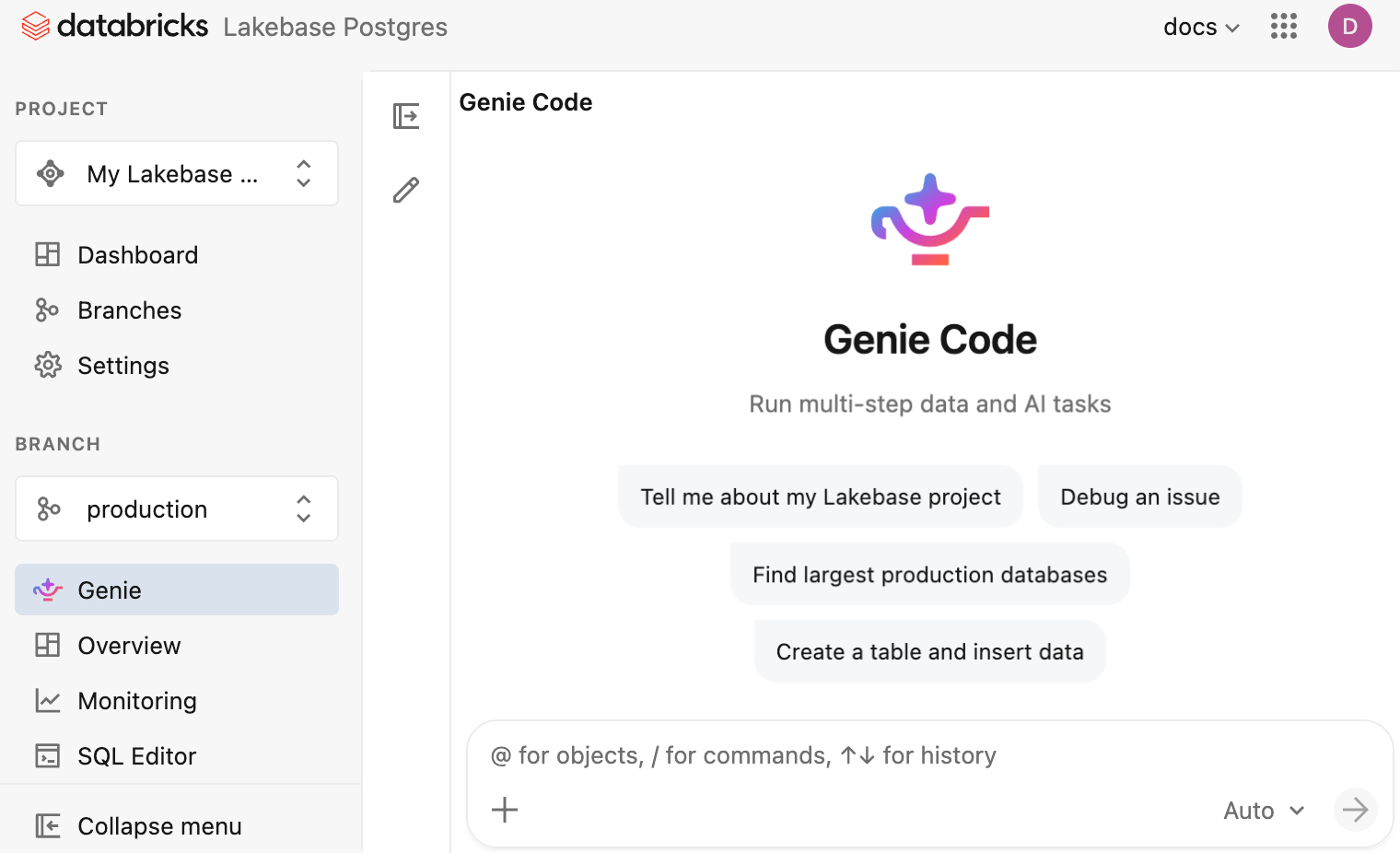
A new Genie entry in the Lakebase project sidebar opens Genie Code, the agentic Databricks assistant, scoped to your Lakebase project. Ask it in natural language to run multi-step data and AI tasks: explore your databases and tables, investigate and debug issues, and create and populate tables. It's the same Genie Code you use elsewhere in Databricks, here working on your Lakebase project, and it's now available for all Lakebase projects. See Genie Code.
Lakebase Postgres APIs are now generally available
August 14, 2026
Programmatic management of Lakebase Postgres is now generally available through the REST API, Databricks CLI, and Databricks SDKs (Python, Java, Go). These interfaces support operations for projects, branches, endpoints, databases, roles, credentials, synced tables, and catalogs. See Lakebase API guide.
Lakebase now supports PCI-DSS and HITRUST
August 10, 2026
Lakebase is now PCI-DSS and HITRUST compliant for workspaces with the compliance security profile enabled. On AWS, this support is limited to the us-east-1 region. On Azure, all regions where Lakebase is available are supported. See Data protection.
Lakebase is enabled by default in compliance security profile workspaces
August 5, 2026
Lakebase is now enabled by default in workspaces with the compliance security profile, including workspaces that use the HIPAA, C5, or TISAX standard and workspaces that enable the profile without a compliance standard. You no longer need to enable Lakebase in these workspaces. See Data protection.
Diagnose and fix Lakebase issues with Genie, using telemetry in Unity Catalog (Beta)
July 24, 2026
Lakebase adds AI-assisted troubleshooting: database issues and early warnings are surfaced to you with Insights, and you can then investigate and fix them conversationally with Genie. Both draw on database telemetry captured to Unity Catalog. See Observability.
Lakebase now provides a service level agreement (SLA)
July 15, 2026
Lakebase now provides a Service Level Agreement (SLA), with Monthly Uptime Percentage commitments for endpoints in zone-redundant high availability mode and for single-compute endpoints. For details, see Lakebase SLA.
Lakebase is now SOC 2 Type 2 compliant
July 14, 2026
Lakebase is now SOC 2 Type 2 compliant. For our SOC reports, please ask your Databricks account team or see Compliance.
Lakebase update notifications now post 3 days in advance
July 10, 2026
To deliver Postgres version updates, security patches, and new features to your projects sooner, Lakebase has shortened the planned update notification window. Planned updates are now posted at least 3 days in advance, rather than 7. You can check your project's settings for upcoming updates.
See Manage updates.
Lakebase now available in AWS Tokyo region (ap-northeast-1)
June 30, 2026
Lakebase is now available in ap-northeast-1 (Asia Pacific - Tokyo). For all supported regions, see Region availability. To get started, see Get a Postgres database.
Lakebase now supports Postgres 18
June 18, 2026
Lakebase now supports Postgres 18. Postgres 17 remains the default version. To use Postgres 18, select it when creating a new project. For a full list of supported versions, see Postgres compatibility.
Lakebase Search adds vector, keyword, and hybrid search to Postgres (Beta)
June 16, 2026
Lakebase Search brings scalable vector and keyword search to Lakebase projects through two new Postgres extensions, so you can run semantic and exact-term search in a single database without a separate search stack:
lakebase_vectoradds thelakebase_annindex type for approximate nearest-neighbor vector search. It is drop-in compatible with pgvector, using the same types, operators, and query syntax, and scales to over 1 billion vectors on a single index with builds up to 50-100x faster than HNSW.lakebase_textadds thelakebase_bm25index type for BM25 full-text search. It works with standardtsvectortypes and operators, adding BM25 ranking and top-K pushdown that PostgreSQL's native GIN index does not provide.
Indexes are storage-backed, so they are available immediately after scale-to-zero without warmup. Combine both extensions for hybrid search that returns semantic and exact-term matches in one ranked list. To get started, enable Lakebase Search in your project settings, then install the extensions. See Lakebase Search, or read the announcement blog post.
Lakebase snapshot storage is now billed
June 1, 2026
Starting June 1, 2026, snapshot storage is billable for Lakebase. Snapshot storage size is shown on the Backup & Restore page. For pricing details, see the Lakebase pricing page. To learn about managing snapshots, see Snapshots.
Postgres password authentication is now disabled by default for new Lakebase projects
May 21, 2026
New Lakebase projects now have native Postgres password authentication disabled by default. Existing projects are unaffected. To allow native Postgres roles to connect with static passwords, enable password connections in project settings. See Manage password connections.
Customer-managed keys for Lakebase available in all AWS and Azure regions
May 20, 2026
Customer-managed keys (CMK) for Lakebase are now available in all Lakebase regions on AWS and Azure. CMK encrypts Lakebase project data at rest using a key your organization owns in its cloud KMS. CMK is available for new Lakebase projects. See Customer-managed keys for Lakebase.
Lakebase now supports compute sizes up to 64 CU (128 GB)
May 20, 2026
Lakebase now supports compute sizes up to 64 CU (128 GB RAM), up from the previous maximum of 32 CU (64 GB RAM). Larger workloads can now use dynamic scaling. See Autoscaling.
Recover a deleted Lakebase project within 7 days
May 15, 2026
When you delete a Lakebase project, it now enters a soft-deleted state for 7 days before permanent deletion. You can recover the project during that window, restoring all branches, databases, endpoints, and project settings. See Recover a deleted project.
New Lakebase instances now scale to zero by default
May 13, 2026
New Lakebase instances now scale to zero by default after 24 hours of inactivity, reducing compute costs for idle projects. To learn more about scale to zero, see Scale to zero. To configure scale to zero, see Configure scale to zero. To change the scale to zero default for new Lakebase projects, see Compute defaults. This change does not affect existing projects.
Lakebase Change Data Feed (CDF) is now in Public Preview
May 12, 2026
You can now store every insert, update, and delete on your Lakebase Postgres tables as Unity Catalog managed Delta tables. Lakebase Change Data Feed (CDF) captures row-level changes from the write-ahead log for downstream pipelines, models, and audit, with no external CDC stack to run. See Lakebase Change Data Feed.
Lakebase OpenTelemetry export (Beta)
April 20, 2026
You can now export Lakebase Postgres metrics and logs to any OTLP-compatible observability backend, including Grafana Cloud, New Relic, and Datadog. Configure the endpoint, authentication, and resource attributes from the Lakebase App. This feature is in Beta.
See OpenTelemetry export.
Lakebase: Customer-managed keys
April 14, 2026
You can now manage encrypted Lakebase project data using a customer-managed key (CMK) from your own cloud KMS. This gives your organization full control over encryption and helps meet regulatory and compliance requirements. See Customer-managed keys for Lakebase.
Lakebase databases as Databricks Apps resources
March 16, 2026
You can now add Lakebase databases as resources for your Databricks app. See Add a Lakebase resource to a Databricks app.
Lakebase updates: OAuth role management, budget policies and tags, and Lakehouse sync
March 12, 2026
Lakebase now includes the following features:
- OAuth roles: Create OAuth roles using the Lakebase UI or REST API, in addition to SQL. See Create Postgres roles.
- Budget policies and tags: Associate a serverless budget policy and add custom tags to your project for cost attribution and tracking. See Manage projects.
- Lakehouse sync (Beta): Continuously replicate Lakebase Postgres tables to Unity Catalog Delta tables using CDC. See Lakebase Change Data Feed.
New Lakebase instances include autoscaling by default
March 12, 2026
New Lakebase instances are now created with autoscaling compute, scale-to-zero, branching, and instant restore by default. This applies when you create instances using the UI, Database instance API, Terraform, or SDKs. See Autoscaling.
Lakebase is now generally available with compliance security profile
March 4, 2026
Lakebase is now generally available for workspaces with the compliance security profile when the compliance standard is set to HIPAA, C5, TISAX, or None.
See Lakebase compliance.
Lakebase now includes high availability
March 2, 2026
Lakebase now includes high availability. A high availability endpoint pairs your primary read/write compute with one to three secondary compute instances across availability zones. If the primary becomes unavailable, Lakebase automatically promotes a secondary and your application continues from the last committed transaction, with no connection string changes. You can optionally serve read traffic from the secondary compute instances for read offload. See High availability.
Lakebase now available in three additional regions
March 2, 2026
Lakebase is now available in three additional regions:
ca-central-1(Canada Central)eu-west-2(Europe – London)sa-east-1(South America – São Paulo)
See Get started with Lakebase.
Lakebase is now generally available
January 22, 2026
Lakebase is now generally available. GA includes autoscaling, scale-to-zero, instant branching, automated backups, point-in-time recovery, an adjustable storage quota, and expanded region availability.
See Get started with Lakebase Postgres.
Manage Lakebase from the Lakebase App
January 15, 2026
Lakebase is now managed through the Lakebase App, accessed from the apps switcher in the Databricks UI. This replaces the previous workflow of navigating to the Compute tab in the Lakehouse UI.
Connect to Lakebase from the SQL editor with read-write access
December 18, 2025
Lakebase (Public Preview) now supports direct connections from the SQL editor with full read-write access. See Query from SQL editor in the workspace.
Lakebase metrics dashboard
December 18, 2025
Lakebase now includes a Metrics dashboard in the Lakebase App for monitoring system and database health. Open Monitoring > Metrics to see graphs for RAM and CPU usage, connection counts, database size, compute cache hit rate, working set size, row operations, deadlocks, and replication delay. Select a branch, compute, and time range to scope the view. See Metrics dashboard.
Lakebase ACL support
December 17, 2025
Lakebase (Public Preview) now supports Access Control Lists (ACLs). Grant CAN CREATE or CAN MANAGE permissions to control who can access and manage project resources. Manage permissions from project settings in the Lakebase App. See Manage project permissions.
Lakebase now in Public Preview
December 12, 2025
Lakebase is now in Public Preview on AWS. This new version of Lakebase introduces autoscaling compute, scale-to-zero, database branching, instant restore, and a redesigned project-based interface. To allow users to explore the new version, usage of Lakebase is free for a limited time. Billing for Lakebase usage begins in January 2026. See Get started with Lakebase Postgres.
Lakebase (Beta) now available
October 30, 2025
Lakebase (Beta) is now available on AWS as a new app in the app switcher, separate from the existing Lakebase Public Preview. This new version introduces autoscaling, scale-to-zero, database branching, instant restore, and project-based organization with a redesigned UI.