Core concepts for attribute-based access control (ABAC)
Attribute-based access control (ABAC) is an access-control model that uses governed tags and policies to grant permissions based on object attributes rather than per-object grants. This page defines the building blocks: governed tags, the four ABAC policy types (row filter, column mask, GRANT, and DENY policies (Beta)), the permissions required to configure them, and the separation of duties ABAC enables across teams.
See Attribute-based access control in Unity Catalog for an overview of all ABAC topics, including tutorials, policy management, best practices, and limitations.
What is ABAC?
Attribute-based access control (ABAC) is a dynamic access control model where access decisions are based on policies evaluated against attributes associated with securable objects. In Unity Catalog, these attributes are represented through governed tags. These governed tags are used in policy conditions to match data objects within a given scope, such as a catalog or a schema. This allows a single policy to apply automatically across multiple data objects that meet its conditions.
For example, an ABAC policy might mask all columns tagged PII for tables within schemas tagged HR. As new data objects are created and tagged, the policy applies automatically without requiring separate policy definitions for each object.
ABAC supports row and column-level security through row filter policies and column mask policies on tables. Row filter policies restrict which rows a user can see. Column mask policies control how column values are presented to users. For a comparison with table-level row filters and column masks, see When to use ABAC vs table-level row filters and column masks.
ABAC also supports dynamic privilege grants through GRANT policies, on supported securable types. See ABAC GRANT policies.
ABAC can also explicitly deny privileges through DENY policies (Beta), currently scoped to the MANAGE ACCESS CONTROL privilege. A DENY policy always takes precedence over any grant. See ABAC DENY policies (Beta).
Governed tags
In Unity Catalog, attributes are implemented as governed tags. Governed tags are key-value pairs defined at the account level and applied to Unity Catalog securable objects such as catalogs, schemas, tables, columns, models, and volumes, in addition to workspace objects. They represent characteristics such as sensitivity, classification, or business domain.
By default, securables inherit tags from their parent catalog or schema. You can override inherited tags at every level except the column level: column tags do not inherit from the parent table and must be applied directly.
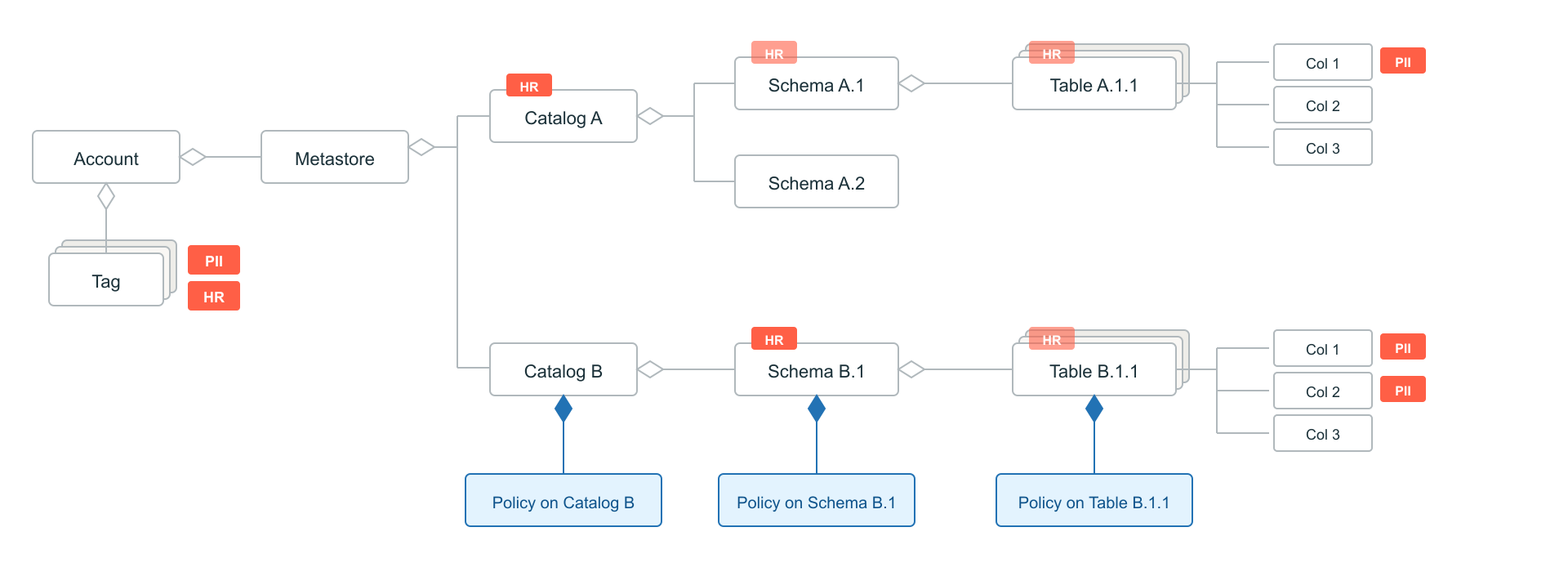
Governed tags can be referenced in policy conditions using built-in functions like has_tag() and has_tag_value(), which check whether a given tag is present on the target data object, either directly or through tag inheritance.
Governed tags are defined at the account level. This means that you can use the same tag taxonomy across your entire data estate in an account, including across multiple metastores.
For more information, see Governed tags and Apply tags to Unity Catalog securable objects.
Policies
Policies are attached to securable objects in Unity Catalog to define access control rules based on tag conditions. Below is an example:
CREATE FUNCTION mask_pii(val STRING) RETURNS STRING
    RETURN '***';

CREATE POLICY mask_pii_for_hr
ON CATALOG catalog_a
COLUMN MASK mask_pii
TO `account users` EXCEPT `HR admins`
FOR TABLES
WHEN has_tag('HR')
MATCH COLUMNS has_tag('PII') AS pii_col
ON COLUMN pii_col;
Each policy specifies:
- Scope: The securable object where the policy is attached, specified by the
ONclause. Attaching a policy to a securable object means the policy conditions are evaluated for all objects of the type specified in theFORclause, across that object and all of its descendants.- For row filter and column mask policies, supported policy scopes are
CATALOG,SCHEMA, orTABLE. For GRANT policies, supported policy scopes areCATALOGandSCHEMA. You can also attach any policy type at theMETASTORElevel so it applies across every catalog in the metastore. See Metastore-level ABAC policies (Beta). - Tables, including streaming tables, materialized views, and views (Beta), are the supported securable type for row filter and column mask policies, specified using the
FOR TABLESclause. GRANT policies apply to models, model services, model provider services, MCP services, agent services (Beta), and skills (Beta), and use theGRANT <privilege> FOR <securable_type>clause. For the full list of supported securable types and privileges, see Supported securable types and privileges. - A policy attached at the metastore evaluates against all securables of the type specified in the
FORclause across every catalog in the metastore. A policy attached at a catalog evaluates against all securables of that type within that catalog. A policy attached at a schema evaluates against all securables of that type within that schema. A policy attached at a table evaluates only against that table.
- For row filter and column mask policies, supported policy scopes are
Databricks recommends attaching policies at the highest applicable level, usually the catalog, to maximize governance efficiency. See Best practices for ABAC policies.
- Principals: Who the policy applies to and who is exempt. The
TOclause specifies the users, groups, or service principals subject to the policy. The optionalEXCEPTclause excludes specific principals from this policy. - Actions: Whether the policy applies a row filter, a column mask, or a privilege grant. Row filter and column mask policies use a user-defined function (UDF) to implement the filtering or masking logic. GRANT policies do not use UDFs. See Policy types.
- Conditions: Tag-based expressions that determine which tables or columns the policy targets. See Conditions and built-in functions.
Policies are created and managed through the UI or programmatically with SQL statements, such as CREATE POLICY, DROP POLICY, SHOW POLICIES, or DESCRIBE POLICY, REST APIs, Databricks SDKs, or Terraform. See Create and manage ABAC policies for the full syntax and examples.
Policy types
ABAC supports four policy types: row filter policies, column mask policies, GRANT policies, and DENY policies (Beta). Row filter and column mask policies require UDFs to implement the filtering or masking logic. GRANT and DENY policies don't use UDFs, and instead grant or deny privileges when their tag-based condition matches the target object's attributes.
Row filter policies
Row filter policies restrict which rows a user can see in a table based on values in columns identified by tags that match the Conditions and built-in functions. The policy references a UDF that evaluates each row. Rows where the function returns FALSE are excluded from query results. Arguments are passed to the UDF through the USING COLUMNS clause.
Example use case: For a sales catalog, ensure the EMEA team sees only EMEA sale records across all tables that have a column tagged region.
CREATE FUNCTION filter_by_region(region STRING, allowed STRING) RETURNS BOOLEAN
    RETURN region = allowed;

CREATE POLICY regional_access_emea
ON CATALOG sales
ROW FILTER filter_by_region
TO `emea team`
FOR TABLES
MATCH COLUMNS has_tag('region') AS rgn
USING COLUMNS (rgn, 'EMEA');
Column mask policies
Column mask policies control what values a user sees for specific columns identified by tags that match the Conditions and built-in functions. The policy references a UDF that takes the column value as input and returns the original value or a masked version. The masked column value is bound automatically as the first argument from the ON COLUMN clause, and additional arguments can be passed through USING COLUMNS. The return type must match or be castable to the column's data type.
Example use case: Mask SSN columns tagged with pii : ssn so that users see ***-**-XXXX (last four digits only) unless they are in a compliance group exempt from the policy.
CREATE FUNCTION mask_ssn(ssn STRING, show_last INT) RETURNS STRING
    RETURN CONCAT('***-**-', RIGHT(ssn, show_last));

CREATE POLICY mask_ssn_columns
ON CATALOG hr_catalog
COLUMN MASK mask_ssn
TO `account users` EXCEPT `compliance team`
FOR TABLES
MATCH COLUMNS has_tag_value('pii', 'ssn') AS ssn_col
ON COLUMN ssn_col
USING COLUMNS (4);
The USING COLUMNS clause passes arguments to the UDF. It accepts aliases for columns that match a tag-based expression, or constant values (quoted strings, numeric literals, boolean values (TRUE/FALSE), or NULL), supplied in the order the function expects them. It also accepts tag introspection functions, which extract a tag's value at query time and pass it to the UDF. For column mask policies, these are additional arguments beyond the masked column (which is bound automatically from ON COLUMN). This allows a single UDF to be reused across policies with different parameters.
SQL UDFs are recommended for better performance. Python UDFs registered in Unity Catalog are also supported, though the query optimizer cannot inline or optimize them the way it can SQL UDFs. See Performance considerations for guidance on UDF language selection.
GRANT policies
GRANT policies dynamically grant a Unity Catalog privilege when their tag-based condition matches a securable object's tags. Each time a user attempts to access a securable object, Unity Catalog identifies all GRANT policies whose scope covers the object, checks whether the user is in the TO list and not in the EXCEPT list, and evaluates the policy's WHEN condition against the tags on the securable, including inherited tags. If the policy applies, Unity Catalog grants the privilege. GRANT policies use the same evaluation model as row filter and column mask policies, except they do not use UDFs. The condition is expressed inline in the policy definition.
The effective privileges on an object are the union of direct grants and any applicable GRANT policies. A principal has the privilege if a GRANT policy in scope applies to that principal or a direct GRANT of the same privilege applies. GRANT policies only add access. They cannot revoke access that was granted directly.
DENY policies (Beta)
DENY policies are in Beta, currently scoped to the MANAGE ACCESS CONTROL privilege. See ABAC DENY policies (Beta) for syntax, examples, and Beta limitations.
DENY policies explicitly deny a Unity Catalog privilege to principals on the securable objects in their scope, and always take precedence over any grant of the same privilege, whether direct, inherited, or held through object ownership. Like GRANT policies, DENY policies are attached at the catalog or schema level, use tag-based conditions, and do not use UDFs. When multiple DENY policies apply to the same principal, their effects are combined, and no grant can override an active DENY. See ABAC DENY policies (Beta).
Conditions and built-in functions
Conditions are tag-based expressions that determine which tables and columns a policy targets within its scope.
- Table conditions (
WHENclause): Boolean expressions that match tables based on their tags. If omitted, defaults toTRUE, meaning the policy applies to all tables in scope. - Column conditions (
MATCH COLUMNSclause): One or more comma-separated boolean expressions that identify which columns the policy targets. Each expression can be a single built-in function likehas_tag('pii'), or a combination using logical operators likehas_tag_value('pii', 'ssn') AND has_tag('sensitive'). Each expression can be assigned an alias (specified afterAS) that can be referenced in theON COLUMNandUSING COLUMNSclauses. A policy can include up to 3 column expressions, and all must match for the policy to apply.
Both clause types use the following built-in functions, evaluated by Unity Catalog against securable metadata:
Function | Context | Description |
|---|---|---|
| Tables and columns | Returns true if the resource has the specified tag. In table conditions ( |
| Tables and columns | Returns true if the resource has the specified tag with the specified value. Same context behavior as |
To match on the attributes of the user running the query instead of on resource tags, see Identity attribute functions.
To match on the context of a request, such as the calling application, see Context attribute functions.
Tags don't propagate from tables to columns. Using has_tag() in a MATCH COLUMNS clause only matches column-level tags, not tags on the parent table or its ancestors.
The has_tag and has_tag_value functions use snake_case naming. The older camelCase forms (hasTag, hasTagValue) continue to work but aren't recommended. Databricks plans to deprecate camelCase forms when creating new policies. Existing policies aren't affected.
Example: using two column conditions. A customers schema has tables with an email column tagged pii : email and a consent column tagged consent_to_contact. The policy masks email addresses unless the customer has consented to be contacted. It uses two column conditions:
has_tag_value('pii', 'email')identifies the column that contains email addresses (the column to mask).has_tag('consent_to_contact')identifies the column that contains consent information (used by the UDF to decide whether to mask).
CREATE FUNCTION mask_email_by_consent(email STRING, consent BOOLEAN)
RETURNS STRING
RETURN CASE
  WHEN consent = true THEN email
  ELSE '****@****.***'
END;

CREATE POLICY mask_email_with_consent
ON SCHEMA customers
COLUMN MASK mask_email_by_consent
TO `account users`
FOR TABLES
MATCH COLUMNS has_tag_value('pii', 'email') AS m,
  has_tag('consent_to_contact') AS c
ON COLUMN m
USING COLUMNS (c);
This policy only applies to tables that have both a column tagged pii : email and a column tagged consent_to_contact. If a table does not have columns matching both conditions, the policy does not apply and the data is returned unmasked.
Identity attribute functions (Beta)
Identity attributes in ABAC policies are in Beta. To use them, an account admin must:
- Enable the Identity Attributes in ABAC Policies preview from the account console Previews page. See Manage account-level previews.
- Configure identity attribute provisioning for the account. See Identity attributes.
Identity attribute functions evaluate properties of the user running the query, such as department, country, or job role. These attributes can be provisioned from your identity provider and referenced directly in policy conditions. This lets you express more flexible conditions without creating separate groups for every combination of identity properties. When identity information changes in your identity provider, policies use the updated attribute values, just as they use updated group membership.
Do not use identity attributes to store sensitive information.
Function | Context | Description |
|---|---|---|
| Column mask ( | Returns |
| Column mask ( | Returns |
These functions are supported in the WHEN clause of column mask policies.
Keep the following behavior in mind when you write policies that use them:
- A missing attribute resolves to
false. If the user has no value for the attribute, has no attributes at all, or the attribute does not exist, the function returnsfalserather than raising an error. Phrase conditions so that thisfalseresult restricts access. See Identity attribute conditions. - Attribute keys and values are case-sensitive and compared exactly:
Financeandfinancedo not match. - Attribute changes are not instant. Changes in your identity provider are not synced to Databricks immediately. See identity attributes for more information.
For the attributes Databricks supports and how they are provisioned, see identity attributes. For examples of how to use identity attributes in policies, see Mask a column based on attributes of the querying user.
Context attribute functions (Beta)
Context attributes in ABAC policies are in Beta. To use them, an account admin must enable the UC ABAC Context Attributes preview from the account console Previews page. See Manage account-level previews.
Context attributes are used to restrict data access for requests made on a user's behalf through an OAuth application. This setup can be used to restrict agents from accessing data when they act on behalf of a user, while keeping that same data accessible if the user queries it directly in the workspace.
It covers any OAuth application, whether a built-in app like the Databricks CLI or a custom OAuth app. There are two different context attributes:
request.is_on_behalf_of: the string'true'or'false'. Indicates if the request is executed on behalf of a user through an OAuth app. Any request from an OAuth app has this value set to'true'.request.client_id: the OAuth client ID. This can be used to target a specific OAuth client, either a built-in OAuth app (for example,databricks-cli) or a custom OAuth app. Theclient_idcan be observed under Settings > App Connections in the account console. For Databricks Apps, it can also be observed on the app's Authorization details page, under OAuth2 App Client ID. Or, it can be queried from theidentity_metadata.acting_resourcefield in the audit logs.
These attributes are not user-modifiable and are explicitly provided by the system. A caller influences them only by how they authenticate. These attributes can be used to identify external agents, not for Genie.
Context attributes can be used through the following functions:
Function | Context | Description |
|---|---|---|
| Column mask & Row filter ( | Returns |
| Column mask & Row filter ( | Returns |
Attribute keys are case-insensitive, and values are case-sensitive.
To learn how to use these context attributes to control access from external agents, see Restrict access for external agents acting on behalf of a user.
User-defined functions (UDFs)
Row filter and column mask policies use user-defined functions (UDFs) to implement their filtering or masking logic. See SQL and Python user-defined functions (UDFs) in Unity Catalog for how to create and manage UDFs, and Common patterns for row filtering and column masking for examples.
Tag introspection functions
Tag introspection functions extract the value of a governed tag and pass it to a UDF through the USING COLUMNS clause. Because the UDF receives the tag value as an argument, a single policy and UDF can handle multiple tag values, rather than requiring a separate policy for each tag value. These functions are available only for row filter and column mask policies, because GRANT policies do not use UDFs.
Creating a policy that uses these functions requires Databricks Runtime 18 LTS or above. This requirement applies only to policy creation, not to querying the governed tables.
Databricks Runtime 18 is newer than Databricks Runtime 18.0, 18.1, and 18.2. Features that would previously have shipped as a later numbered version now ship as dated updates to Databricks Runtime 18 instead. For details, see About unified release notes.
At query time, Unity Catalog evaluates these functions against the tags on the table or columns the policy matches: get_tag_value() reads from the table that satisfies the WHEN condition, and get_column_tag_value() reads from the columns identified by MATCH COLUMNS. They can appear only in the USING COLUMNS clause, not in WHEN or MATCH COLUMNS conditions.
Function | Context | Description |
|---|---|---|
| Tables | Returns the value of the specified tag applied to the table being accessed, or inherited from its parent schema or catalog. Returns |
| Columns | Returns the value of the specified tag applied directly to a matched column. Unlike |
Both functions take the tag key as a string literal. The tag must be a governed tag, and get_column_tag_value() must reference an alias that exists in the policy's MATCH COLUMNS clause. If the tag is not governed or the alias is not valid, policy creation fails. If a referenced tag is no longer governed when a query runs, queries against the policy's target tables fail at runtime.
Example: One policy for all PII types
Without tag introspection, masking each type of personally identifiable information (email, SSN, phone) requires a separate policy and UDF for each tag value. With get_column_tag_value(), a single policy passes the matched column's pii tag value to one UDF. The UDF branches on that value:
CREATE FUNCTION mask_pii(col STRING, pii_type STRING)
RETURNS STRING
RETURN CASE
  WHEN pii_type = 'email' THEN regexp_replace(col, '(^[^@]+)', '***')
  WHEN pii_type = 'ssn' THEN '***-**-' || right(col, 4)
  WHEN pii_type = 'phone' THEN '***-***-' || right(col, 4)
  ELSE col
END;

CREATE POLICY mask_all_pii
ON CATALOG main
COLUMN MASK mask_pii
TO `account users`
FOR TABLES
MATCH COLUMNS has_tag('pii') AS col
ON COLUMN col
USING COLUMNS (get_column_tag_value(col, 'pii'));
For each masked column, get_column_tag_value(col, 'pii') resolves to that column's pii tag value (email, ssn, phone, etc.), and mask_pii applies the matching transformation. A new tag value only requires a new branch in the UDF, not a new policy.
Separation of duties and permissions
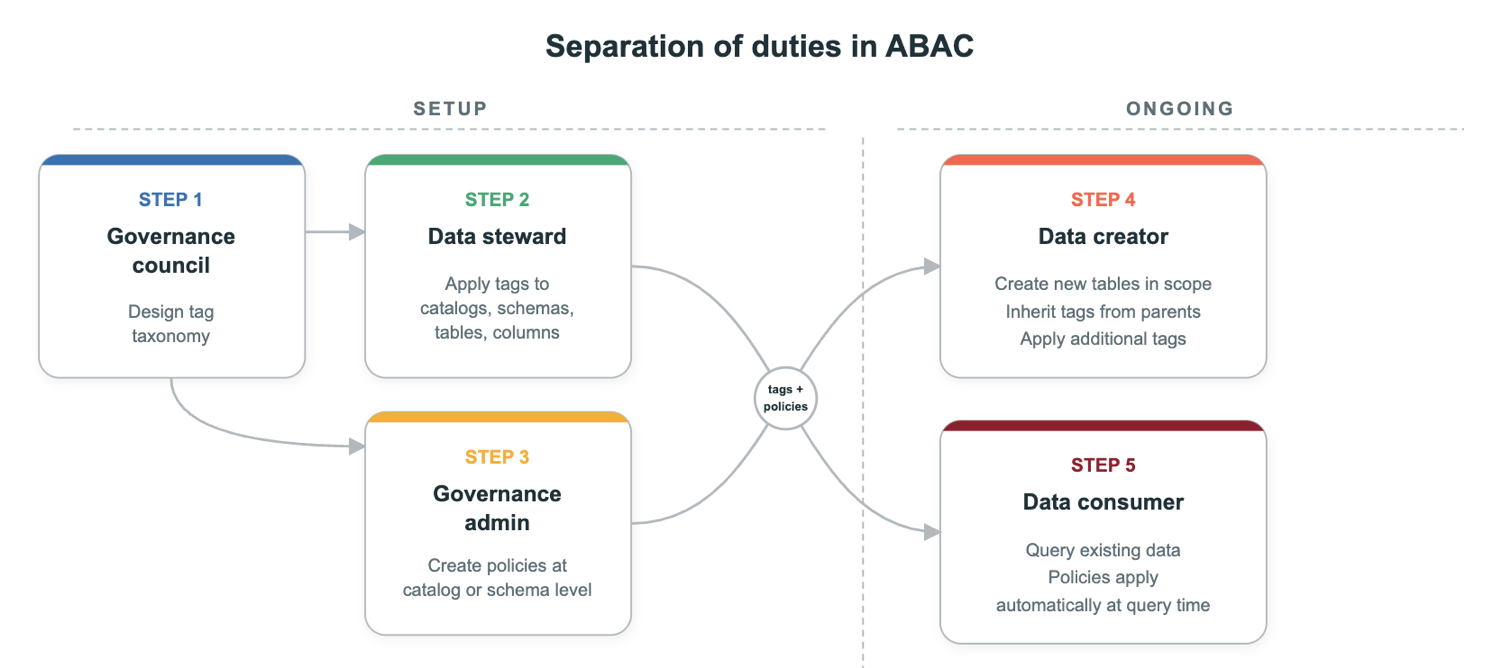
Setting up ABAC involves several steps, each with its own permission requirements. Organizations can distribute these tasks across specialized groups depending on how they choose to separate duties. For example, an organization can define a tag taxonomy centrally, then have data stewards classify data, governance admins write policies, data creators create objects within governed scopes, and data consumers access the governed objects.
-
Create the tag taxonomy. Define the governed tag keys and their allowed values before anyone applies them or writes policies. For example, create a
sensitivitytag with controlled values (public,internal,confidential,restricted) or apiitag with values likessn,email, andphone_number. See Standardize attributes and naming for recommendations on naming conventions and taxonomy design.- Required permissions: Account admin, or a user with
CREATEpermission for tags at the account level.
- Required permissions: Account admin, or a user with
-
Tag data assets. A data steward, data creator, or AI classification system applies governed tags to Unity Catalog securable objects such as catalogs, schemas, tables, columns, models, and volumes. For example, tag columns that contain personally identifiable information with
pii : ssn, or tag a model withlifecycle : production. Correct tagging is the essential first step for ABAC policies to apply.- Required permissions:
ASSIGNon the tag, andAPPLY TAGon the object.
- Required permissions:
Tagging is a security boundary. If a user can change tags on a data asset, they can change which policies apply to it. Organizations should control who can apply tags and audit tag changes.
-
Create a policy. A governance admin creates a policy at a scope, such as a catalog or schema. The policy specifies who it applies to, what conditions it evaluates, and the action to apply, such as a row filter, a column mask, or a privilege grant.
- Required permissions:
MANAGEpermission or object ownership on the securable object where the policy is attached. For row filter and column mask policies, alsoEXECUTEprivilege on the UDF.
- Required permissions:
-
Create data objects. Data creators create securable objects such as tables, models, or volumes within the scopes to which they were granted access. New objects inherit tags from parent catalogs and schemas. Data creators also have
APPLY TAGautomatically on objects they create, so they can apply additional tags. Alternatively, they can rely on automatic data classification to handle tagging. If an organization relies on data creators to tag their own objects, it should establish clear tagging practices. Data creators do not need to configure any access controls if policies are set at higher levels, which Databricks recommends.- Required permissions:
CREATE TABLEor other relevant creation privileges on the parent object.
- Required permissions:
-
Access governed objects. When a user attempts to access a securable object within a policy's scope, Unity Catalog evaluates applicable policies automatically. For row filter and column mask policies, the user sees filtered or masked data if the table or columns match the policy's conditions and the user is not exempt. For GRANT policies, the user gains the granted privilege if the conditions match and the user is in
TOand not inEXCEPT.- Required permissions: For row filter and column mask policies, users must be granted permissions on the table, such as
SELECT, through a direct object grant. These policies filter records or mask columns for tables the user can already access. They do not grant permissions on their own. GRANT policies grant the privilege themselves and union with any direct grants on the same securable.
- Required permissions: For row filter and column mask policies, users must be granted permissions on the table, such as
Benefits of ABAC
-
Reusable policies based on attributes: A single policy can apply to multiple data objects that match the same attribute-based conditions, rather than being tied to one specific object.
-
Automatic application to new objects: When new data objects are created within scope and tagged with the relevant attributes, existing ABAC policies apply without additional configuration. Policies act like future grants, which means that access controls apply automatically as new data is created and tagged appropriately.
-
Consistent enforcement within a scope: Policies attached at the catalog or schema level are evaluated dynamically against matching data objects in that scope, which removes differences in how similar data is filtered or masked.
-
Lower ongoing maintenance: Changes can be made by updating policy logic or governed tags, rather than revisiting each individual object as is required with table-level row filters and column masks.
-
Centralized governance: Because policies can be defined once and applied across many matching data objects, governance teams can manage controls across larger parts of the data estate with fewer policy definitions.